Curling Canada’s Ice Technician Education Program expanded its reach and impact during the 2025–26 season, delivering dozens of courses and hundreds of training opportunities aimed at strengthening ice-making expertise across the country.
Built around the promise of supporting an ice technician’s journey, every step of the way, the program is creating and supporting highly skilled technicians who can elevate ice conditions in Canada’s 800-plus curling centres. The education pathway includes three levels: Assistant Ice Technician (AIT), Head Ice Technician (HIT) and Competition Ice Technician (CIT), each aligned to different stages of professional development.
Across the 2025–26 season, Curling Canada and its Provincial and Territorial Member Associations delivered 37 courses, reaching 364 participants nationwide.
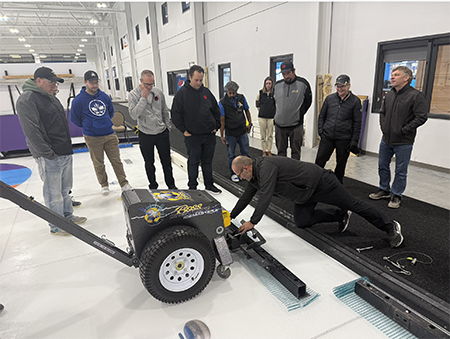
“The level of interest we saw this season was tremendous. Participants came to every course eager to learn, ask questions and be better ice techs,” said Greg Ewasko, Curling Canada’s chief ice technician. “That’s what makes the program so valuable. We are building a community of ice technicians who help each other improve their skills at their local curling centres.”
The goals of the programs were to support ice technicians who work or volunteer at their local curling centre. In total, 22 Assistant Ice Technician courses trained 223 participants, while 13 Head Ice Technician courses supported another 118. These sessions were delivered in partnership with member associations including Curl BC, Curling Alberta, Curling NT, CURLSASK, CurlManitoba, Curling Ontario, Curling Québec, Curling New Brunswick and Nova Scotia Curling.
“One of our program goals is to provide a clear and robust training and certification pathway for ice technicians,” said Dustin Mikush, Curling Canada’s ice technician programming manager. “With more than 800 affiliated curling centres, we have a responsibility to provide meaningful education and development opportunities that support people who are new to the craft and our most experienced ice technicians advancing their skills. Together with our Provincial and Territorial Member Associations, we are strengthening the system so ice technicians have the expertise to provide high-quality playing conditions from coast to coast to coast.”
Curling Alberta played a significant role in the season’s delivery, hosting three AIT courses, one HIT course and a Club Tour designed to strengthen local expertise.
“Curling Alberta is proud to partner with Curling Canada to strengthen and grow the Ice Technician Program in our province,” said Jill Groves, Curling Alberta’s executive director. “High-quality ice is fundamental to the curler experience at every level, and investing in skilled ice technicians is one of the most important ways we can support our clubs, competitions, and volunteers.”
Groves noted the importance of sustained investment in education and mentorship as participation demands evolve, reinforcing the value of ongoing development.
“As we continue to expand our own ice technician team and increase our investment in this area, we remain committed to providing education, mentorship, and development opportunities that build capacity throughout our province and enhance the game for every curler,” she said.
Curling Canada revised its delivery model for the Head Ice Technician course, testing a two-day in-person format with pre-course online learning. The change was positive, as it gave participants the chance to maximize their in-person time and improved overall accessibility to the course.
At the national level, Curling Canada also delivered its Competition Ice Technician program, which focuses on preparing technicians for championship-level ice conditions. Two pilot CIT courses were held during the season: one in Cochrane, Alta., and another in Sudbury, Ont., training a combined total of 23 participants from across B.C., Alberta, the Northwest Territories, Saskatchewan, Northern Ontario, Ontario, Québec, and Newfoundland and Labrador.
The updated curriculum adds content on professionalism, customer service and preparing ice for high-performance training environments. It also has updated modules for ice preparation for youth, mixed doubles and wheelchair curling.
“Getting in-person video feedback on my pebbling was extremely useful,” said Sudbury participant Paul Norman. “The combination of hands-on work, especially with the rocks, and the group discussions made the learning really stick. It’s the kind of course that challenges you and gives you practical tools you can take straight back to your club.”
Three national webinars attracted more than 700 participants. Those sessions covered pebbling and clipping, ice-side discussions with experts and ice preparation during national championship events.
Looking ahead, Curling Canada is preparing initiatives for the coming season, including facilitator and evaluator training in Chilliwack, B.C., continued webinar programming, and the second year of a pilot project focused on arena championship job shadowing and evaluation. A “Thank an Ice Tech Week” campaign is also planned for January 2027.
Additional information about Curling Canada’s Ice Technician programs is available through Provincial and Territorial Member Associations or by contacting icetech@curling.ca.