


Accordion Content
(a) The length of the ice sheet from the inside edges of the back boards is minimum 45.720 metres (minimum 150 feet). The width of the sheet from the inside edges of the side lines is a maximum of 4.750 m (15 ft. 7 inches). This area is delineated by lines drawn, or by dividers placed on the perimeter. If the size of an existing facility will not permit these measurements, then the length may be reduced to a minimum of 44.501 m (146 ft.), and the width to a minimum of 4.420 m (14 ft. 6 in.).
(b) At each end of the sheet there are clearly visible parallel lines in the ice from side line to side line as follows:
- the tee line, 13 mm (1/2 in.) maximum width, placed so that the centre of the line is 17.375 m (57 ft.) from the middle of the sheet.
- the back line, 13 mm (1/2 in.) maximum width, placed so that the outside edge is 1.829 m (6 ft.) from the centre of the tee line.
- the hog line, 102 mm (4 in.) in width, placed so that the inside edge is 6.401 m (21 ft.) from the centre of the tee line.
- the centre line, 13 mm (1/2 in.) maximum width, joins the midpoints of the tee lines and extends 3.658 m (12 ft.) beyond the centre of each tee line.
- the hack line, 457 mm (1 ft. 6 in.) in length and 13mm (1/2 in.) maximum width, is placed parallel to the tee line, at each end of the centre line.
- the courtesy line, 152 mm (6 in.) in length and 13mm (1/2 in.) maximum width, is placed 1.219 m (4 ft.) outside and parallel to the hog lines, on each side of the sheet.
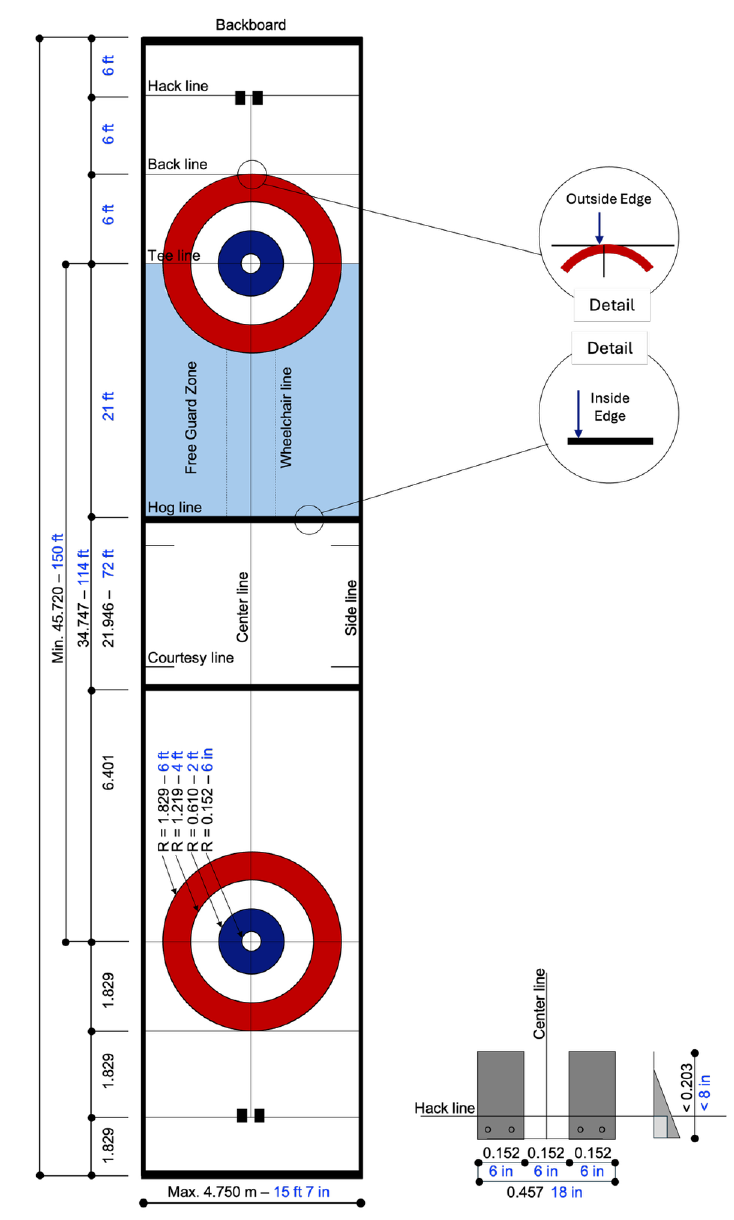
(c) For wheelchair events, at each end of the sheet, 2 thin (i.e. – wool) wheelchair lines are placed parallel to and on opposite sides of the centre line, extending from the hog line to the outermost edge of the nearest circle, with the outside edge of each line being 457 mm (18 in.) from the centre line.
(d) A centre hole (tee) is placed at the intersection of each tee line and centre line. With the tee as centre, there are four concentric circles placed at each end of the sheet, with the outer edge of the outer circle having a radius of 1.829 m (6 ft.), the next circle a radius of 1.219 m (4 ft.), the next circle a radius of 610 mm (2 ft.), and the innermost circle having a minimum radius of 152 mm (6 in.).
(e) Two hacks are placed on the hack line, on opposite sides of the centre line, with the inside edge of each hack 76 mm (3 in.) from the midpoint of the centre line. The width of each hack shall not exceed 152 mm (6 in.). The hack is attached to suitable material, and the inside edge of that material is placed on the inside edge of the hack line so that the hack does not extend more than 203 mm (8 in.) in front of the hack line. If the hack is recessed into the ice, this is not to be more than 38 mm (1.5 in.) in depth.
(a) A curling stone is of circular shape, having a circumference no greater than 914 mm (36 in.), a height no less than 114 mm (4.5 in.), and a weight, including handle and bolt, no greater than 19.96 kg (44 lbs.) and no less than 17.24 kg (38 lbs.).
(b) Each team uses a set of eight stones having the same handle colour and individually identified by visible markings. If a stone is damaged and becomes unsuitable for play, a replacement stone is used. If a replacement stone is not available, a stone previously delivered in the end is redelivered.
(c) If a stone is broken in play, the teams use the “Spirit of Curling” to decide where the stone(s) should be placed. If agreement cannot be reached, the end will be replayed.
(d) If a stone rolls over while in motion, or comes to rest on its side or top, it is removed from play immediately.
(e) Should a handle completely separate from a stone during delivery, the delivering player has the option of either allowing the play to stand, or of redelivering the stone after any displaced stones have been replaced to their positions prior to the incident taking place.
(f) A stone that does not come to rest completely beyond the inside edge of the hog line at the playing end is removed from play immediately, except when it strikes another stone, in which case it remains in play.
(g) A stone that completely crosses the outside edge of the back line at the playing end is removed from play immediately.
(h) A stone that touches a divider or a side line is removed from play immediately and is prevented from entering adjacent sheets.
(i) A stone may be measured only visually until the last stone of the end has come to rest, except to determine if a stone is in play, or, prior to playing the second, third, fourth or fifth stone of an end, to determine if a stone is in the Free Guard Zone or in the No-Tick Zone.
(j) Teams are not to make alterations to, nor place any object on or over, their game stones.
(a) A team is composed of four players. A team may also include a fifth player, acting as an alternate and team officials. Each player delivers two stones, in consecutive order in each end, while alternating with an opponent.
(b) A team declares its delivery rotation, and the skip and vice-skip functions, prior to the start of a game and maintains that rotation and those functions throughout that game subject to rule R3 (c)I. A team that deliberately changes its delivery rotation, or functions, during a game will forfeit the game, unless it was done when bringing in an alternate player.
(c) Where a player is unable to deliver one or both of their allocated stones in an end, the team may:
- immediately bring in an alternate in the position of the departing player. The replaced player may not re-enter the game. If desired, the team may change the line-up at the start of the next end. The revised rotation and functions will then apply for the rest of that game; or
- continue play with three players for the remainder of that end and the following full end. A player who leaves the game and does not deliver all of their stones in any given end, may re-enter only at the start of an end. A maximum of 4 stones allocated to the missing player may be delivered as per rule R3 (f) or (g). At the completion of these two consecutive ends the team must continue the game with four players delivering stones, either by having the departing player return or by bringing in an alternate. Failure to do so results in forfeiture of the game.
Each team is permitted only one instance per game of a player being absent (unable to deliver their allocated stones).
(d) A team may not play with fewer than three players, all players delivering all their allocated stones in each end.
(e) In competitions where alternates are allowed, only one alternate can be registered and used in that competition. If there is a violation, the offending team will forfeit the game.
(f) If a player delivers the first allocated stone of an end and is unable to deliver the second allocated stone, the following is the procedure for the remainder of that end, if the player is not replaced immediately. If the player is the:
- first player, the second player delivers the stone.
- second player, the first player delivers the stone.
- third player, the second player delivers the stone.
- fourth player, the third player delivers the stone.
(g) If a player whose turn it is to deliver is unable to deliver both of the allocated stones during an end, the following is the procedure for the remainder of that end, if the player is not replaced immediately. If the player is the:
- first player, the second player delivers three stones, then the third player delivers three stones, then the fourth player delivers the last two stones.
- second player, the first player delivers three stones, then the third player delivers three stones, then the fourth player delivers the last two stones.
- third player, the first player delivers the first stone of the third player, then the second player delivers the second stone of the third player, then the fourth player delivers the last two stones.
- fourth player, the second player delivers the first stone of the fourth player, then the third player delivers the second stone of the fourth player.
(a) Non-Delivering Team:
I. During the process of delivery, the players take stationary positions along the side lines between the courtesy lines. However:
- two players may take stationary positions behind the back line at the playing end but must not interfere with the choice of place of the skip or vice-skip of the delivering team.
- the player who is to deliver next may take a stationary position to the side of the sheet, behind the hack at the delivery end.
II. The non-delivering team players must not take any position, nor cause any motion, which could obstruct, interfere with, distract or intimidate the delivering team. If such an action occurs, or an external force distracts a player during delivery, that player has the option of allowing the play to stand, or of redelivering the stone after all displaced stones have been replaced to their positions prior to the violation taking place.
(b) Delivering Team:
- The skip, or the vice-skip when it is the skip’s turn to deliver, or when the skip is not on the ice, is in charge of the house.
- The player in charge of the house is positioned inside the hog line, with at least one foot/wheel on the ice surface of the playing end of the team’s sheet, while the team is in the process of delivery.
- If the skip, or vice-skip, are not in the Field of Play, and it is either the skip’s or vice-skip’s turn to deliver, any on-ice player of that team can be in charge of the house for that stone.
- Any improper position of players will result in the delivered stone being removed from play, and any displaced stones shall be replaced, by the non-offending team, to their positions prior to the violation taking place.
(a) Unless predetermined or decided by the Last Stone Draw (LSD), the teams opposing each other in a game shall use a coin toss to determine which team delivers the first stone in the first end. This order of play shall be maintained until one team scores, after which the team that most recently scored delivers the first stone in any subsequent end.
(b) Unless predetermined, the team playing the first stone of the first end has the choice of stone handle colour for that game.
(c) Right-handed deliveries are delivered from the hack on the left of the centre line and left-handed deliveries are delivered from the hack on the right of the centre line. A stone delivered from the wrong hack is removed from play, and any displaced stones are replaced, by the non-offending team, to their positions prior to the violation taking place.
(d) The curling stone must be delivered using the handle of the stone. Touching the granite at any time after the tee line at the delivery end is not allowed and considered a touched moving stone which results in the stone being removed from play.
(e) A stone must be clearly released from the hand before it reaches the hog line at the delivery end. If the player fails to do so, the stone is immediately removed from play by the delivering team.
(f) If a hog line violation stone is not immediately removed and strikes another stone, the delivered stone must be removed from play by the delivering team, and any displaced stones are replaced, by the non-offending team, to their positions prior to the violation taking place.
(g) A stone is in play when it reaches the tee line (hog line for wheelchair curling) at the delivery end. A stone that has not reached the relevant line may be returned to the player and redelivered.
A stone is considered delivered when it reaches the hog line at the delivery end.
(h) All players must be ready to deliver their stones when their turns come, and not take an unreasonable amount of time to play.
(i) If a player delivers a stone belonging to the opposing team, that stone is allowed to come to rest, and is then replaced by a stone belonging to the delivering team.
(j) If a player delivers a stone out of proper rotation, the end continues as if the mistake had not occurred. The player who missed a turn delivers the last stone for that team in that end. If it cannot be determined which player delivered out of proper rotation, the player who delivered the first stone in the end for that team delivers the last stone for that team in that end.
(k) If a player inadvertently delivers too many stones in one end, the end continues as if the mistake had not occurred, and the number of stones allocated to the last player of the offending team shall be reduced accordingly. If the player delivering the last stones of an end is the player that inadvertently delivers too many stones, the last delivered stone will be removed from play and any displaced stones are replaced, by the non-offending team, to their positions prior to the violation taking place.
(l) If a team delivers two stones in succession in the same end:
- the second stone is removed, and any displaced stones replaced, by the non-offending team, to their positions prior to the violation taking place. The player who delivered the stone played by mistake, redelivers it as the last stone for the team in that end.
- should the infraction not be discovered until after the delivery of a subsequent stone, the end is replayed.
(m) If the wrong team delivers the first stone of an end:
- if the error is discovered after only the first stone has been delivered, the end shall be replayed.
- if the error is discovered after the 2nd stone of the end has been delivered, play continues as if the error had not occurred.
(a) A stone that comes to rest between the tee line and the hog line at the playing end, excluding the house, is deemed to be within an area designated as the FGZ. Also, stones that are in play, on or before the hog line, after striking stones in the FGZ, are deemed to be in the FGZ.
(b) If, prior to the delivery of the sixth stone of an end, a delivered stone causes either directly or indirectly, an opposition stone to be moved from the FGZ to an out-of-play position, then the delivered stone is removed from play, and any displaced stones are replaced, by the non-offending team, to their positions prior to the violation taking place.
(a) If, prior to the delivery of the sixth stone of an end, a delivered stone causes either directly or indirectly, an opposition stone in the Free Guard Zone (FGZ) which is touching the centre line to be moved to an off-centre line position or to a position outside the FGZ, the nonoffending team has the option to:
I. Remove the delivered stone from play, and replace all stones that were displaced to their positions prior to the violation taking place; or
II. Leave all stones where they came to rest.
(b) If the stone is moved from the centre line to an out-of-play position, then the FGZ rule R6(b) applies.
(c) This rule does not apply for Wheelchair Curling or for Mixed Doubles competitions.
(a) Sweeping can be in any direction (it need not cover the entire width of a stone), the brush head must not be raised in front of a moving stone, must not deposit debris in front of a moving stone, and sweeping must finish to either side of a stone.
In officiated play, the umpires will observe sweeping. If they see a violation when a team is sweeping their own stone, an official warning will be issued to the entire team.
For any subsequent violation(s) during the same event by the same team, the following will be applied:
I. If the violation occurs during a Last Stone Draw (LSD), the maximum distance will be recorded;
II. If the violation occurs during the game, the non-offending team has the choice to either:
- Allow the stone to remain in play, or
- Remove the delivered stone and replace any displaced stones to their positions prior to the violation taking place
- Allow the stone to remain in play, or
(b) A stationary stone must be set in motion before it can be swept. A stone set in motion by a delivered stone, either directly or indirectly, may be swept by any one or more of the team to which it belongs anywhere in front of the tee line at the playing end.
(c) All players may clean the playing surface prior to the delivery of the next stone.
(d) A stone in play may be swept by any one or more of the delivering team anywhere in front of the tee line at the playing end.
(e) No player may ever sweep an opponent’s stone except behind the tee line at the playing end and may not start to sweep an opponent’s stone until it has reached the tee line at the playing end.
(f) Behind the tee line at the playing end, only one player from each team may sweep at any one time. This may be any player of the delivering team, but only the skip or vice-skip of the non-delivering team.
(g) Behind the tee line, a team has first privilege of sweeping its own stone, but it must not obstruct or prevent its opponent from sweeping.
If a sweeping violation occurs, (b) to (g), the non-offending team has the option of allowing the play to stand, or of placing the stone, and all stones it would have affected, where they would have come to rest had the violation not occurred.
(a) Between the tee line at the delivery end and the hog line at the playing end:
I. If a moving stone is touched, or is caused to be touched, by the team to which it belongs, or by their equipment, the touched stone is removed from play immediately by that team. A double touch of the stone handle by the person delivering the stone, prior to the hog line at the delivering end, is not considered a violation.
II. If a moving stone is touched, or is caused to be touched, by an opposition team, or by their equipment, or is affected by an external force:
- If the stone was the delivered stone, it is redelivered.
- If the stone was not the delivered stone, it is placed where the team to which it belongs reasonably considers it would have come to rest had it not been touched.
- If the stone was the delivered stone, it is redelivered.
(b) Inside the hog line at the playing end:
I. If a moving stone is touched, or is caused to be touched, by the team to which it belongs, or by their equipment, all stones are allowed to come to rest, after which the non-offending team has the option to:
- remove the touched stone, and replace all stones that were displaced after the infraction to their positions prior to the violation taking place; or
- leave all stones where they came to rest; or
- place all stones where they reasonably consider the stones would have come to rest had the moving stone not been touched.
- remove the touched stone, and replace all stones that were displaced after the infraction to their positions prior to the violation taking place; or
II. If a moving stone is touched, or is caused to be touched, by an opposition team, or by their equipment, all stones are allowed to come to rest, after which the non-offending team places the stones where it reasonably considers the stones would have come to rest, had the moving stone not been touched.
III. If a moving stone is touched, or is caused to be touched, by an external force, all stones are allowed to come to rest, and then placed where they would have come to rest if the incident had not occurred. If the teams cannot agree, the stone is redelivered after all displaced stones have been replaced to their positions prior to the violation taking place. If agreement on those positions cannot be reached, the end is replayed.
(c) Last Stone Draw (LSD) stones:
- If a member of the delivering team touches a moving stone, or causes it to be touched, the stone will be removed and recorded as 1.996 m (6 ft. 6.5 in.).
- If a member of the non-delivering team touches a moving stone, or causes it to be touched, the stone will be redelivered.
- If an external force touches a moving stone, or causes it to be touched, the stone will be redelivered.
(d) If a moving stone is touched by a stone deflecting off the sheet dividers, the non-delivering team shall place the stone where it reasonably considers the stone would have come to rest had the moving stone not been touched.
(a) If a stationary stone which would have had no effect on the outcome of a moving stone is displaced, or caused to be displaced, by a player or their equipment, it is replaced, by the non-offending team, to their positions prior to the violation taking place.
(b) If a stationary stone which would have had no effect on the outcome of a moving stone is displaced, or caused to be displaced, by an external force, it is replaced, with agreement of the teams, to its position prior to the violation taking place.
(c) If a stone which would have altered the course of a moving stone is displaced, or caused to be displaced, by a player or their equipment, all stones are allowed to come to rest and then the non-offending team has the option to:
- leave all stones where they came to rest; or
- remove from play the stone whose course would have been altered, and replace any stones that were displaced after the violation to their positions prior to the violation taking place; or
- place all stones in the positions the team reasonably considers they would have come to rest had a stone not been displaced.
- leave all stones where they came to rest; or
(d) If a stone which would have altered the course of a moving stone is displaced, or caused to be displaced, by an external force, all stones are allowed to come to rest and are then placed in the positions in which they would have come to rest had a stone not been displaced. If the teams cannot agree, the stone is redelivered after all displaced stones have been replaced to their positions prior to the violation taking place. If agreement on those positions cannot be reached, the end is replayed.
(e) If a displacement is caused by stones deflecting off the sheet dividers, the stones are replaced, by the non-delivering team, to their positions prior to the violation taking place.
(f) Last Stone Draw (LSD) Stones:
- If a member of the delivering team displaces a stationary stone, or causes it to be displaced, before the official completes the measurement, the stone will be removed and recorded as 1.996 m (6 ft. 6.5 in.).
- If a member of the non-delivering team displaces a stationary stone, or causes it to be displaced, before the official completes the measurement, the stone is replaced, by the delivering team, to its position prior to the violation taking place.
- If an external force displaces a stationary stone, or causes it to be displaced, before the official completes the measurement, the stone is replaced, by the delivering team, to its position prior to the violation taking place.
(a) No player shall cause damage to the ice surface by means of equipment, handprints or body prints. The procedure will be:
1st incident = 1st official on-ice warning, repair damage.
2nd incident = 2nd official on-ice warning, repair damage.
3rd incident = repair damage and eject player from the game.
(b) No equipment shall be left unattended anywhere on the ice surface.
(c) Teams must not use electronic communication equipment or any device to modify the voice, during a game. With the exception of stopwatches that are limited to providing ‘time’ data only, the use of electronic devices during the games, which provide information to players on the athletes’ field of play, are forbidden. A whistle or another signalling instrument can be used in case of medical reason and after consultation and written approval from the curling organization having jurisdiction.
(d) When an electronic hog line system is being used:
- The handle must be properly activated so that it is functioning during the delivery, or it will be considered a hog line violation stone.
- A glove or mitt must not be worn on the delivery hand during the delivery of a stone. If there is a violation, the delivered stone shall be removed from play, and any displaced stones shall be replaced, by the non-offending team, to their positions prior to the violation taking place.
(e) The use of a delivery stick shall be restricted as follows:
- The delivery stick may not be used in any World Curling competition or qualifying event, except wheelchair events.
- Players choosing to deliver with a delivery stick must use a delivery stick for the delivery of all their stones during the entire game.
- A delivery stick shall not convey any mechanical advantage other than acting as an extension of the arm/hand.
- All delivery sticks must conform to the Wheelchair Curling Policy.
- For the use of a delivery stick in non-wheelchair curling competitions, refer to the document “World Curling recommendations for Delivery Sticks in Recreational Play”.
(a) The result of a game is decided by a majority of points at the completion of the scheduled ends of play, or when a team concedes victory to its opponent, or when one team is arithmetically eliminated, provided the minimum number of ends has been completed. A team that has been arithmetically eliminated may finish the current end, but no new end may be started. However, if a team is arithmetically eliminated in the last end of a game, the game must stop when this occurs, and the end will not be finished. If the score is tied at the completion of the scheduled ends, play continues with extra end(s) and the team that scores first wins the game.
(b) At the completion of an end (when all stones have been played), a team scores one point for each of its own stones located in or touching the house that are closer to the tee than any stone of the opposition.
(c) The score of an end is decided when the skips or vice-skips in charge of the house agree upon the score. If stones that may have affected the points scored in an end are displaced prior to that decision, the non-offending team receives the benefit that might have accrued from a measurement.
(d) When determining the score of an end, if teams cannot visually decide which stones are closer to the tee, or whether a stone is touching the house, a measuring device is used. Measurements are taken from the tee to the nearest part of the stone. Any one player on the ice from each team is allowed to observe any measurement that is made by a measuring device.
(e) If two or more stones are so close to the tee that it is impossible to use a measuring device, the determination is made visually.
(f) If a decision cannot be reached, either visually or with a measuring device, the stones are considered equal, and:
- If the measure was to determine which team scored in the end, the end is blanked.
- If the measure was to determine additional points, only the stones closer to the tee are counted.
(g) Should an external force cause the displacement of stones that would have affected the score prior to agreement of the score the following applies
- If the displaced stones would have determined which team scored in an end, the end is replayed.
- If a team secured a point(s), and the displaced stone(s) would have determined if an additional point(s) was scored, that team has the option of replaying the end or of keeping the point(s) already secured.
(h) If a measure is required to determine the correct score in a final end, and the result of the measure does not affect the outcome of the game, a displacement of the stone(s) by an external force before the measurement is completed will not result in the end being replayed and the Chief Umpire will determine the score of the final end.
(i) A team concedes a game only when it is the delivering team. When a team concedes the game before the completion of an end, the score of the end is determined at that time, in the following manner:
I. If both teams still have stones to be delivered, “X”s are placed on the scoreboard.
II. When only one team has delivered all of its stones:
- If the team that delivered all its stones has stone(s) counting, no points are given, “X”s are placed on the scoreboard unless the points are required to determine the outcome.
- If the team that did not deliver all its stones has stone(s) counting, these points are given and placed on the scoreboard.
If no stones are counting, “X”s are placed on the scoreboard.
(j) The final score of a forfeited game is recorded as “W – L” (win – loss).
(k) If one or both teams are not available to start a game at the designated time, the following takes place:
| Team #1 | Team #2 | Both teams |
0:00 – 0:59 seconds late for the start of the game | If only team #1, no penalty. Use LSD or coin toss (if required) to determine LSFE. Score 0 – 0 | If only team #2, no penalty. Use LSD or coin toss (if required) to determine LSFE. Score 0 – 0 | If both teams, no penalty. Use LSD or coin toss (if required) to determine LSFE. Score 0 – 0 |
1:00 – 14:59 (1:00 – 9:59 for Mixed Doubles) | If team #1 is late then team #2 has last stone advantage, one end is considered completed. Score is 0 – 1 | If team #2 is late then team #1 has last stone advantage, one end is considered completed. Score is 1 – 0 | If both teams are late then one end is considered completed, use LSD or coin toss (if required) to determine last stone. Score is 0 – 0 |
15:00 – 29:59 (10:00 – 19:59 for Mixed Doubles) | If team #1 is late then team #2 has last stone advantage, two ends are considered completed. Score is 0 – 2 | If team #2 is late then team #1 has last stone advantage, two ends are considered completed. Score is 2 – 0 | If both teams are late then two ends are considered completed, use LSD or coin toss (if required) to determine last stone. Score is 0 – 0 |
30:00 minutes (20:00 for Mixed Doubles) – or more | If team #1 is late then it forfeits the game and team #2 is declared the winner. Final score is recorded with a L and W. | If team #2 is late then it forfeits the game and team #1 is declared the winner. Final score is recorded with a W and L. | If both teams are late then the game is considered over and both teams take a loss. If one team ‘must’ advance in the draw, then the DSC would decide, if no DSC done, then a coin toss will decide. |
If one team is 1:00 – 14:59 (1:00 – 9:59 MD) min. late and the other team is 15:00 – 29:59 (10:00 – 19:59 MD) min. late: two ends will be considered played, the team that was 1:00 – 14:59 (1:00 – 9:59 MD) min. late receives last stone advantage and 1 point. | |||
If for any reason, a game is interrupted, the game recommences where play was stopped. In the case that the stones need to be removed for ice maintenance (agreement between Chief Ice Technician, Chief Umpire and Event Manager), then the end is replayed.
(a) Stones are delivered from a stationary wheelchair.
(b) When the stone is delivered between the hack and the outermost edge of the top of the house at the delivery end, at the start of the delivery the stone is positioned on the centre line. When the stone is delivered between the outermost edge of the top of the house and the hog line at the delivery end, the entire width of the stone must be within the wheelchair lines at the start of the delivery.
During delivery, no part of the delivering player’s body can touch the ice surface and the wheels of the chair must be in direct contact with the ice.
The delivery of the stone is undertaken by an arm/hand release or using a delivery stick conforming to the Wheelchair Curling Policy. Stones must be clearly released from the hand or stick before the stone reaches the hog line at the delivery end.
(c) During the process of delivery, the non-delivering team players must take stationary positions behind the back line at the delivering end. However, any two players may take stationary positions behind the back line at the playing end, but must not interfere with the choice of place of the skip or vice-skip of the delivering team.
(d) Sweeping is not permitted.
(e) If a delivery violation occurs, (b) or (d), the delivered stone must be removed from play, and any displaced stones shall be replaced, by the non-offending team, to their positions prior to the violation taking place.
(f) For World Curling wheelchair competitions, each on-ice team must have four players delivering stones and must be comprised of both genders at all times during games. A team violating this rule will forfeit the game.
If a player leaves during an end because of illness, accident, or other extenuating circumstances (excluding ejection by an umpire):
- the player may return to the game, provided they deliver all their allocated stones.
- if the departing player’s stone(s) need to be delivered in that end, an alternate must be immediately brought into the game in the position of the departing player to deliver those stone(s), and the team still needs to be composed of both genders. Failure to do so results in forfeiture of the game. At the start of the next end the team may change the team line-up if desired (the revised rotation of play will apply for the remainder of that game), and the replaced player may not re-enter the game.
- if both stones have been delivered by the departing player, at the start of the next end the team must bring in an alternate and may change the team line-up if desired (the revised rotation of play will apply for the remainder of that game), and the replaced player may not re-enter the game.
(g) All games will be scheduled for 8 ends.
(a) Wheelchair Curling Rules R14 apply with the exception of (f):
In Wheelchair Mixed Doubles Curling a team is composed of two players, one male and one female. Alternate players are not allowed. A team must forfeit any game(s) in which it fails to have both players playing for the entire game. Two team officials are allowed for each team.
(b) Wheelchair Mixed Doubles is played as described under Rule R17, with the exception of rule R17 (l) as there is no sweeping allowed at any time in Wheelchair Mixed Doubles.
(c) Electric wheelchairs are not allowed unless the athlete uses an electric wheelchair for daily mobility.
(a) Each team shall have two male and two female players, and the male and female players must deliver stones alternately (M, F, M, F – or – F, M, F, M). No alternate players are permitted. Two team officials are allowed for each team.
(b) A team must forfeit any game(s) in which it fails to have 4 players playing for the entire game. Where a player is unable to deliver one or both of their allocated stones in one end, a team may continue play with three players for the remainder of that end and the following full end. A player who leaves the game and does not deliver all of their stones in any given end, may re-enter only at the start of an end. A maximum of 4 stones allocated to the missing player may be delivered as per rule R3 (f) or (g). At the completion of these two consecutive ends the team must continue the game with four players delivering stones. Failure to do so results in forfeiture of the game.
Each team is permitted only one instance per game of a player being absent (unable to deliver their allocated stones).
(c) The delivery rotation must maintain the required gender order (M, F, M – or – F, M, F). If required, the delivery rotation must be changed to meet this requirement.
(d) The skip and vice-skip can be anyone in the team, but they must be from opposite genders.
(e) All Mixed games are scheduled for 8 ends.
(a) A team is composed of two players, one male and one female. Alternate players are not allowed. A team must forfeit any game(s) in which it fails to have both players playing for the entire game. Two team officials are allowed for each team.
(b) The scoring shall be the same as in a regular game of curling. The “positioned” stones that are placed prior to the beginning of each end are eligible to be counted in the scoring.
(c) Each game will be scheduled for 8 ends.
(d) Each team shall deliver 5 stones per end. The player delivering the team’s first stone of the end must also deliver the team’s last stone of that end. The other team member shall deliver the team’s second, third and fourth stones for that end. The player delivering the first stone can change from end to end.
(e) If, prior to the delivery of the fourth stone of an end, a delivered stone causes either directly or indirectly, any previous delivered or placed stone to be moved to an out-of-play position, the delivered stone shall be removed from play and any displaced stone(s) shall be replaced, by the non-offending team, to their positions prior to the violation taking place.
(f) Prior to the start of every end, one team shall place its “positioned” stone at the playing end of the sheet in one of two positions, designated A and B. The opponent’s “positioned” stone shall then be placed in whichever position (A or B) remains vacant. The location of these positions shall be as follows:
I. Position A: Placement so that the stone is bisected by the centre line and is either immediately in front of or immediately behind one of 4 points in the ice. The points are placed on the centre line (see diagram):
- 4’6” (1,372 m) from the outermost edge of the top of the house
- 6’6” (1,981 m) from the outermost edge of the top of the house
- 8’6” (2,591 m) from the outermost edge of the top of the house
- 10’6” (3,200 m) from the outermost edge of the top of the house
In officiated play, the Chief Umpire together with the Chief Ice Technician will determine the specific placement for each sheet for Position A, prior to the start of pre-game practice. That same placement must be used for the entire game.
When no event official is available to make the decision, the teams shall determine the specific placement for Position A, prior to the start pre-game practice and based on the ice conditions. The same placement must be used for the entire game.
II. Position B: Placement so that the stone is bisected by the centre line and is in the back of the 4-foot circle. The back edge of the stone is aligned with the back edge of the 4-foot circle (see diagram).
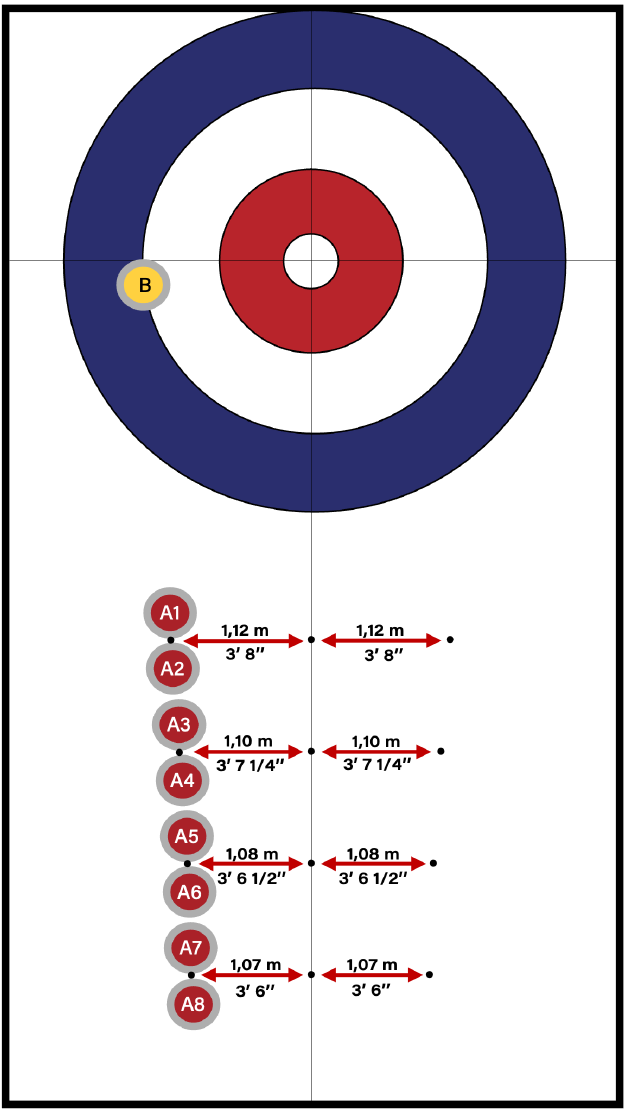
III. Power Play: Once per game, each team, when it has the decision on the placement of the “positioned” stones, can use the “Power Play” option to position those two stones. The in-house stone (B), which belongs to the team with last stone in that end, is placed on either side of the house with the back edge of the stone touching the tee line, at the point where the 8-foot and 12-foot circles meet. The guard stone (A) is positioned to the same side of the sheet, the same distance that was determined for the centre guards (see diagram). The Power Play option cannot be used in extra ends.
(g) The team having the decision on the placement of the “positioned” stones shall be:
- Teams opposing each other in the game shall use the Last Stone Draw (LSD) to determine which team has the decision in the first end. The team with the lesser LSD distance shall have the decision on the placement.
- Following the first end, the team that did not score shall have the decision on the placement.
- If neither team scores in an end, the team that delivered the first stone in that end shall have the decision on placement in the next end. In the case of a blanked end due to an equal measure, the team that had the decision on the placement of the “positioned” stones shall not change for the next end.
(h) If the “positioned” stones are placed in the wrong position:
- If the error is discovered after only the first stone has been delivered, the end shall be replayed.
- If the error is discovered after the 2nd stone of the end has been delivered, play continues as if the error had not occurred.
(i) The team whose “positioned” stone is placed in Position A (in front of the house) shall deliver the first stone in that end, and the team whose “positioned” stone is placed in Position B (in the house) shall deliver the second stone in that end.
(j) If a team delivers a clearly marked “positioned” stone, the last delivered stone of that team is removed from play, as soon as the infraction is realised. If the same violation happens any subsequent time by the same team during the same competition, the team will forfeit the game(s).
(k) Each team is responsible for the placement of their stone. If either team delays the start of an end, their timeclock will be activated. If both teams delay the start of an end, the time clock of the team that must start the end will be started.
If a team is using their Power Play, they must let their opponent know their decision at the end of the 60-second break time, or after 4 ½ minutes (6 ½ minutes in Wheelchair Mixed Doubles) of the mid-game break to allow the opponent to place their stone within the break. If there is a delay, the time-clock of the team calling the Power Play will be started.
(l) While the team is in the process of delivery, the non-delivering player may be anywhere on the ice surface of the team’s sheet. After delivery, either or both players may sweep their delivered stone and any stones set in motion that belong to their team anywhere in front of the tee line at the playing end. This applies during all of the team’s delivered stones, including the LSD.
(m) If a delivery violation occurs, the delivered stone must be removed from play, and any displaced stones shall be replaced, by the non-offending team, to their positions prior to the violation taking place.
Should the infraction not be discovered until after the delivery of a subsequent stone, play continues as if the infraction had not occurred, however, the player that delivered the first stone of the end can deliver a maximum of two stones in that end.
(n) If an end needs to be replayed, the choices of the original end (e.g., position of positioned stones, throwing order) have to stand as they were for the “original” end.
Figure 1 – Centre Guard
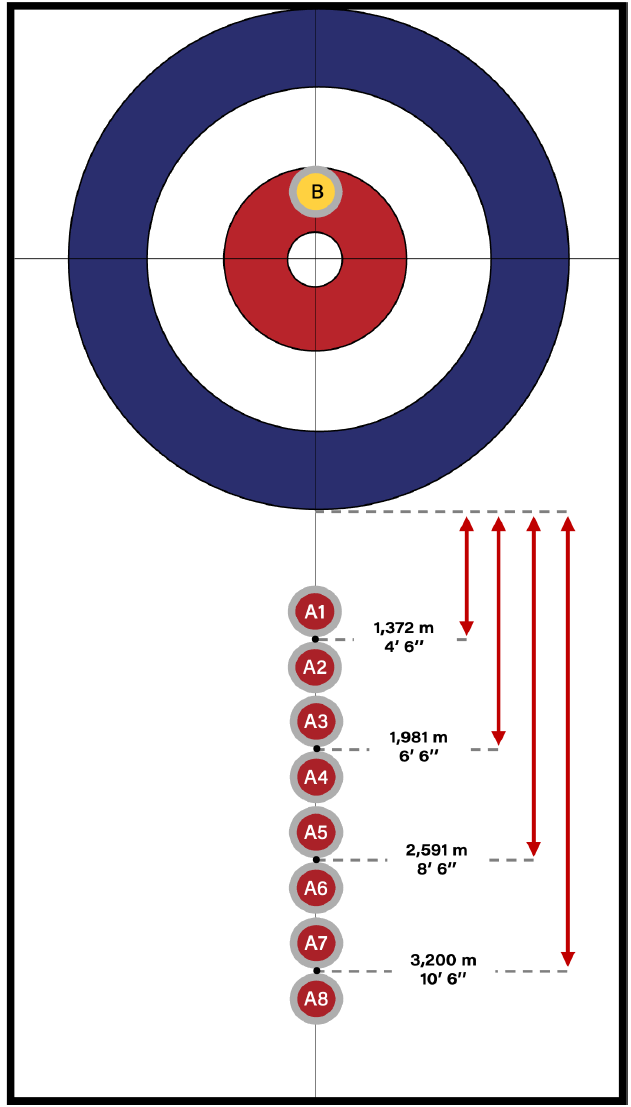
Figure 2 – Power Play Option
The use of all performance-enhancing drugs, without therapeutic use exemption, whether taken knowingly or otherwise, is unethical and prohibited. If such use occurs the player(s) will be disqualified from the competition, their Member Association will be notified, and it could lead to further suspension.
Improper conduct, foul or offensive language, equipment abuse, or wilful damage on the part of any team member is prohibited. Any violation may result in suspension of the offending person(s) by the curling organisation having jurisdiction.
Accordion Content
- These rules apply to:
- Any competition to which these rules are made applicable by the curling governing body having jurisdiction; and
- Any competition within the jurisdiction of Curling Canada including a National Championship where special rules may be in effect.
- If special rules are in effect, they shall take precedence over the Rules of Curling for Officiated Play.
- If a competitors’ guide is issued for a specific event, the guide shall form an integral part of the rules for the event and be enforceable as part of the rules.
- These Rules apply to traditional team play. Special rules for Mixed Doubles, Wheelchair, Stick Curling and other variations of traditional team play are in addition and described in the sections to which they apply.
In these rules and rulings made by Umpires, Curling Canada, and its officers:
- “Biting” means that the vertical projection of a stone is in contact with the sheet line(s) to which the stone is in close proximity.
- “Competition” means a playdown involving any number of teams playing games to determine a winner.
- “Counting stone” means any stationary stone in the house that is closer to the tee than any stationary stone of the opposing team.
- “Delivering team” means the team in control of the house and whose turn it is to deliver.
- “End” means the part of the game in which two opposing teams each deliver eight stones alternately and then determine the score.
- “Game” means play between two teams to determine a winner.
- “House” means the area within and including the outside circle at each end of the sheet.
- “Umpire” means person or persons assigned to oversee a curling game or competition by the curling governing body having jurisdiction.
- “Officiated Play” means play that includes a Chief Umpire, game(s) umpires, hog line umpires or hog line detection devices, observers, time clock operators and time clocks as determined by the rules of the competition.
- “National Championship” means: Canadian Men’s Championship; Canadian Women’s Championship; Canadian Senior Men’s & Women’s Championships; Canadian Junior Men’s & Women’s Championships; Canadian Under-18 boys & Girls Championships; Canadian Mixed Championship; Mixed Doubles Championship; Canadian Wheelchair Championship; Canadian Curling Club Championships; and Canadian University / College Championships
- “Sheet” means an area of ice marked in accordance with Rule 3
- “Delivered stone” means a stone that is in motion from the moment that it has reached the nearer tee line and been released, until it has come to rest or is out of play.
- “Stone set in motion” means a stone in motion whose movement from a stationary position, in play, is caused by a delivered stone or another stone previously set in motion.
- “Team” means three or four players playing together in accordance with Rule 5 and may also include the team alternate and coach as determined by the rules of the competition.
- “Time-out” means stopping the delivering team’s time clock and stopping play.
- “Original position” means the position the stones were in immediately before a violation or incident took place.
- “Violation” means an infraction of a rule as determined by an umpire.
- “Thinking Time” is the allotted time for each team to complete a game. The time clocks will operate while a team deliberates about choice of shot. The clock will stop when the delivering team’s stone reaches the nearer tee-line.
- “Triangulation” is the process of determining the location of a point by forming triangles to it from known points (Wikipedia). Used in the “Last Stone Draw” when a stone is covering the tee and a measurement cannot be taken. The two points used for measurement are at the edge of the four foot circle, 61.0 cm from the tee, at either the three o’clock and six o’clock positions or the six o’clock and nine o’clock positions.
- “Five Rock Rule”: means opposition stones in the Free Guard Zone cannot be moved to an out-of-play position prior to the delivery of the sixth stone of the end.
- “Sweeping Moratorium”: The specifications for brushes in elite curling and all related links on the World Curling Federation website: worldcurling.org.
- “Straight Line Measure” (SLM): A device used to assist in a visual determination if a stone is over or touching a straight line i.e., Hog line, T-Line, Side-Line, Back-Line.
- The recommended length of the sheet from backboard to backboard shall be 146 feet (44.501 metres) to 150 feet (45.720 metres). The width of the sheet from sideline to sideline shall be a minimum of 14 feet 2 inches (4.318 metres) and a maximum of 15 feet 7 inches (4.750 metres). This area shall be delineated by lines drawn or dividers placed on the perimeter.
- The centre line, one-half inch in width, shall be placed the length of the sheet through the centre of the tee lines to a point 12 feet (3.658 metres) behind each tee.
- At each end of the sheet there shall be three distinct lines drawn from sideline to sideline as follows:
- Each tee line, one-half inch in width, shall be placed 12 feet (3.658
metres) from the hack (see image) to the centre of the tee line and there shall be 114 feet (34.747 metres) from the centre of one tee line to the centre of the other tee line. The distance from the backboard to the centre of the tee line shall be 16 feet (4.877 metres) if the length of the sheet is 146 feet (44.501 metres) from backboard to backboard. The distance from the backboard to the centre of the tee line shall be 18 feet (5.486 metres) if the length of the sheet is 150 feet (45.720 metres) from backboard to backboard. The intersection of the tee line and the centre line is called the tee or center pin. - Each back line, one half inch in width, shall be placed 6 feet (1.829 metres) from the centre of the tee line. The back line is a tangent with the outer edge of the 12-foot circle both exactly 6 feet (1.829 metres) from the tee where the back line intersects the centre line.
- The hog line, 4 inches (10.16 centimetres) in width, shall be placed with the inner (circle side) edge 21 feet (6.401 metres) from the centre of the tee line.
- Each tee line, one-half inch in width, shall be placed 12 feet (3.658
- With each tee as centre, there shall be drawn four concentric circles at each end with the outer edge of the outer circle having:
- The twelve-foot circle – a radius of six feet (1.829 metres);
- The eight-foot circle – a radius of four feet (1.219 metres);
- The four-foot circle – a radius of two feet (60.96 centimetres); and,
- The button – a radius of a minimum six inches (15.24 centimetres).
- The marking of the centre line and tee line may be omitted from the button area.
- A tee centre (capable of accepting a measuring device) shall identify the intersection of the tee line and the centre line of each house. The base portion shall be securely anchored at the exact intersection of the tee line and centre line of the house.
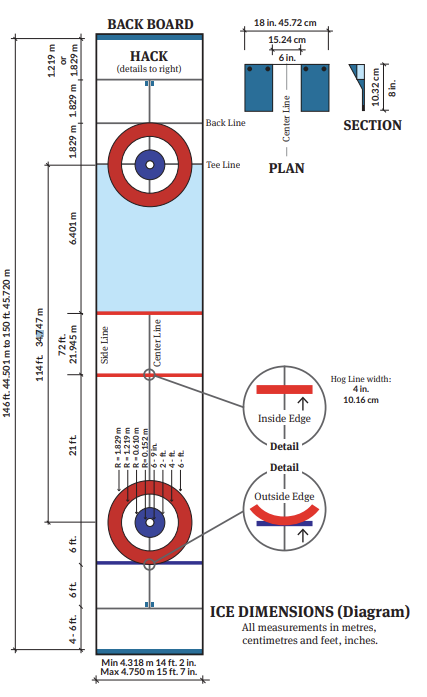
- Hacks:
- The hack(s) used for delivery shall be of a style and size accepted by Curling Canada.
- Each hack shall not exceed 8 inches (20.32 centimetres) in length.
- If two hacks are used, the back edge of each hack shall be placed 12 feet (3.658 metres) from the tee. The inside edge of each hack shall be no further than 3 inches (7.62 centimetres) from the centre line.
- If one moveable or fixed hack is used, it shall be placed with the back edge of the hack 12 feet (3.658 metres) from the tee and be either centered on the centre line or with the inside edge no further than 3 inches (7.62 centimetres) from the centre line (left or right).
- The ‘Ice Dimensions (Diagram)’ shows the proper layout of the sheet in accordance with the measurements in this section.
- A curling stone shall be of circular shape and, including handle and bolt, shall weigh a maximum of 44 lbs. (19.96 kilograms) and a minimum of 38.5 lbs. (17.46 kilograms).
- It shall have a maximum circumference of 36 inches (91.44 centimetres) and shall be a minimum of 4.5 inches (11.43 centimetres) in height, measured between the bottom and top of the stone.
- The radius of the stone is considered to be 14.2 cm for the purpose of the calculation of triangulation.
- Two sets of eight stones shall be assigned for each sheet of play and only the assigned stones shall be used unless otherwise directed by an umpire.
- A team member or coach shall not physically alter the running surface or weight of either teams assigned or selected game stones in any manner. If the violation occurred prior to the delivery of the stone, the umpire shall assign a replacement stone to the offending team. If a replacement stone is not available, the umpire shall allow the redelivery of a previously delivered stone or facilitate the dual delivery of a stone yet to be delivered. If an altered stone is delivered prior to an umpire intervening in the game, the umpire shall allow all stones to come to rest and provide the non-offending team with the option of allowing the play to stand; or having the umpire remove the delivered stone from play and replacing all affected stones as close as possible to their original positions.
- If a stone is broken in play, the umpire shall place a replacement stone where the largest fragment comes to rest. The inside edge of the replacement stone shall be placed in the same position as the inside edge of the largest fragment with the assistance of a measuring stick.
- A stone that rolls over in its course or comes to rest on its side or top shall be removed immediately from play.
- All sixteen stones originally on the sheet at the start of a game shall be delivered in every completed end. No interchange of stones or redelivery of previously delivered stones in that end may occur unless so directed by the umpire.
If a violation of (8) occurs, the umpire shall allow the delivered stone and all affected stones to come to rest and provide the non-offending team with the option of: allowing the play to stand; or having the umpire remove the stone just delivered from play and replacing all affected stones as close as possible to their original positions. - Teams shall not place any sort of cover over the stones under any circumstances.
- Every team shall be composed of a minimum of four players as determined by the rules of the competition except as provided for in (5). Prior to each game, a five-member team shall designate the four eligible members of the team who will commence play as players for that game. If the fifth member is registered as a player, they shall be recognized as the alternate for that game.
- Each player on a four-player team shall deliver two stones in each end alternately with their opponent.
- Unless otherwise specified in the rules of the competition, last stone advantage in the first end (hammer) will be decided by a draw to the button (triangulation used where required) following each team’s pregame practice. This is referred to as the Last Stone Draw (LSD).
- Last stone advantage in the first end will be marked with an asterisk sign in the space allocated for this on the scoreboard. This mark is to note last stone in the first end and is not moved.
- In the second and subsequent ends, the winner of the preceding end shall deliver the first stone of the end.
- If an end is blanked (no score), the team delivering the first stone in the blanked end shall deliver the first stone in the next end.
- The delivery rotation declared by a team prior to the start of a game shall be followed throughout that game except as provided for in (5), (6) or (7).
- Unless otherwise specified in the special rules of the competition:
- A team shall include a minimum of three of four players from the original team.
- A substitute player shall be a team’s designated alternate or other eligible player as provided for in the rules of the competition.
- A team may play with three players with the first two players each delivering three consecutive stones in each end. Under no circumstance may a team play with fewer than three player delivering stones.
Exception: Four-person mixed curling must always have four players on the ice with two men and two women alternating delivery of stones. The skip must deliver fourth stones and the player acting as vice-skip must deliver third stones and be the opposite gender.
- The following are the two accepted position/delivery rotations for 4-person mixed competition:
- male lead (first thrower), female second (second thrower), male third (third thrower and vice-skip), and female skip (fourth thrower).
- female lead (first thrower), male second (second thrower), female third (third thrower and vice-skip), and male skip (fourth thrower).
- A substitute player who joins a team prior to the start of a game may deliver stones in any position of the delivery rotation of the team. The team shall declare their delivery rotation at this time.
- A substitute player who joins a team between ends may deliver stones in any position of the delivery rotation of their team. The team may re-declare their delivery rotation at this time. The designation of skip and vice-skip may also be changed at this time.
- During an end in play, if a player(s) is unable to complete the delivery rotation declared by the team at the start of the game, the team may activate a substitute player(s) subject to:
- A substitute player may only enter a game during an end if they deliver a stone(s) of the sidelined player within that end.
- At the beginning of the next end, the substitute player may deliver stones in any position of the delivery rotation of their team and the team may re-declare their delivery rotation at this time. The designation of skip and vice-skip may also be changed at this time.
- The replaced team member shall not re-join the team until the next game unless the team loses a subsequent player(s) and is therefore placed in a default position as per (5)(a).
- A team that commences a game with three players and expects the fourth player to join the team, the fourth player may enter an end already in progress providing they are able to deliver a stone within the team’s established delivery rotation. Prior to the next end, the team may re-establish the delivery rotation. The designation of skip and vice-skip may also be changed at this time.
- A player, who has left a game without being able to deliver any of their stones during the current end, may re-enter an end already in progress providing that they are able to deliver a stone within the team’s established delivery rotation. A player may leave and return to a game only one time in any game.
- If a substitute player has been activated, the replaced team member shall not re-join the team until the next game except as provided in (5)(f)(iii).
- If a player delivers their first stone of the end and is unable to deliver their second stone of the end and the rules of the competition allow the team to continue play with three players and the team chooses to play with three players, the following procedures shall be followed:
- If the lead player, the second player shall deliver the stone.
- If the second player, the lead player shall deliver the stone.
- If the third player, the second player shall deliver the stone.
- If the fourth player, the third player shall deliver the stone.
- If a player is unable to deliver both of their stones during an end and the rules of the competition allow the team to continue with three players and the team chooses to play with three players, the following procedures shall be followed for the end in progress:
- If the lead player, the second player shall deliver both lead player’s stones and the first of the second player’s stones, and the third player shall deliver the second of the second player’s stones and both third player’s stones.
- If the second player, the lead player shall deliver the first of the second player’s stones, and the third player shall deliver the second of the second player’s stones and both of the third player’s stones.
- If the third player, the lead player shall deliver the first of the third stones and the second player shall deliver the second of the third player’s stones.
- If the fourth player, the second delivers the fourth’s first stone and the third delivers the fourth’s second stone.
- If a player delivers their first stone of the end and is unable to deliver their second stone of the end and the rules of the competition allow the team to continue play with three players and the team chooses to play with three players, the following procedures shall be followed:
Penalty: If a violation of Rule 5(5), 5(6) or 5(7) occurs, the umpire shall allow all stones to come to rest and provide the non-offending team with the option of allowing the play to stand; or having the umpire remove the stone just delivered from play and replacing all affected stones as close as possible to their original position.
- The skip has the exclusive direction of the game for their team and shall deliver stones in each end.
- Subject to Rule 5(5), the skip may play any position in the delivery rotation of their team. Regardless of the position played in the delivery rotation, the player designated as skip shall remain in that capacity throughout the course of that game except as provided for in Rule 5(5), 5(6) and 5(7). Exception: RuIe 5. Teams (5)(c)(i)(ii) Mixed curling.
- When it is the skip’s turn to deliver, they will elect a teammate to act as skip. Subject to Rule 5(4), the vice-skip may play any position in the delivery rotation of their team.
- Regardless of the position played in the delivery rotation, the player designated as vice-skip shall remain in that capacity throughout the course of that game except as provided for in Rule 5(6).
- The vice-skip shall assume the responsibilities of the skip when the skip is not on the playing surface. Exception: Mixed curling Rule 5(5)(c) “Exception”.
Penalty: If a violation of Rule 6(1), 6(2), 6(3), 6(4), or 6(5) occurs, the umpire shall allow all stones to come to rest and provide the non-offending team with the option of allowing the play to stand; or having the umpire remove the stone just delivered from play and replacing all affected stones as close as possible to their original position.
- Members of the non-delivering team:
- Only the skip or vice-skip, and one other player may be positioned inside the hog line at the playing end. They shall position themselves behind the back line when the delivering team is in the process of delivery. Both players shall be motionless with their brooms positioned in a manner not to interfere with or distract the attention of the player who is in the process of delivery as provided for in Rule 8(4)(a).
- The player who is next to deliver may take a stationary position to the side of the sheet behind the hacks at the delivery end. The player shall remain silent and motionless when the delivering team player is in the process of delivery as provided for in Rule 8(4)(a).
- The players not taking the positions (1)(a) or (1)(b) shall position themselves between the hog lines and to the extreme sides of the sheet when the delivering team’s time clock is running. The players positioned in this area shall remain in single file when the delivering team player is in the process of delivery as provided for in Rule 8(4)(a).
- The non-delivering team members shall not take any position or cause such motion that would obstruct, interfere with, or distract any member of the delivering team.
Penalty: If a violation of Rule 7(1)(a), 7(1)(b), 7(1)(c) or 7(1)(d) occurs, the umpire shall allow all stones to come to rest and provide the non-offending team with the option of: allowing the play to stand; or recommencing the delivery of the stone; or replacing all affected stones as close as possible to their original position and redelivering the stone. - Members of the delivering team:
The skip or vice-skip directing play shall be positioned between the backboards and the hog line, on the ice, of the playing end while their team is in the process of delivery. They shall have choice of position for the purpose of directing play.Penalty: If a violation of Rule 7(2) occurs, the umpire shall allow all stones to come to rest and provide the non-offending team with the option of allowing the play to stand or having the umpire remove the stone just delivered from play and replacing all affected stones as close as possible to their original position.
- The delivery of a stone by the right hand shall be initiated from the hack located to the left of the centre line. The delivery of a stone by the left hand shall be initiated from the hack located to the right of the centre line.
- If a single, moveable hack is in use, the delivery of a stone by the right hand or the left hand may be initiated from a hack located on the centre line. If a single, moveable hack is in use it shall be positioned as required by the delivering team in accordance with Rule 3(6).
- The delivery and release of a curling stone are intended to occur in a straight line towards the target broom.Penalty: If a violation of Rule 8(1), 8(2) or 8(3) occurs, the umpire shall allow all stones to come to rest and provide the non-offending team with the option of: allowing the play to stand; or having the umpire remove the stone just delivered from play and replacing all affected stones as close as possible to their original position.
- A player – whose team is in control of the house – is in the process of delivery from the time the player is positioned in the hack until
the stone is released. - A player shall only commence a forward progression from the hack with a stone after the previously delivered stone and any stones set in motion have come to rest or have crossed the back line and their team is in control of the house.
- A player – whose team is in control of the house – is in the process of delivery from the time the player is positioned in the hack until
- The stone shall be released before it reaches the hog line at the delivering end.
- If a violation of (5) occurs when the hog line detection device is not being used, the delivered stone and all affected stones shall come to rest before any action is taken. The umpire shall remove the delivered stone from play and replace all affected stones as close as possible totheir original positions.
- If a violation of (5) occurs when the hog line detection device is being used, the red lights displayed in the handle will come on and the delivering team sweepers shall take responsibility for stopping the delivered stone prior to it reaching the playing end and guiding it across the back line and out of play.
- A stone re-touched by the hand after release but re-touched before the hog line is not a violation.
- If a player wishes to recommence the delivery as a result of their team’s action the player may do so providing the stone has not reached the nearer tee line. The player will redeliver the same called shot and ice.
- If in the estimation of the umpire, an extreme circumstance occurs during the delivery that distracts the thrower to a significant degree, the stone may be redelivered prior to the opposition delivering their next stone. The umpire shall allow all stones to come to rest and provide the delivering team with the option of allowing the play to stand; or recommencing the delivery of the stone; or, if required, replacing all affected stones as close as possible to their original positions, and redelivering the stone. The player will redeliver the same called shot and ice.
- If a player delivers a stone belonging to the opposing team, that stone shall be allowed to come to a rest and then is replaced with a stone belonging to the delivering team.
- If a player delivers a stone when it is not their team’s turn to deliver:
- If the error is discovered after only the first stone has been delivered, the end shall be replayed;
- If the error is discovered after the second stone of the end has been delivered, the end shall continue, and the new delivery rotation shall take effect.
- If an error in a team’s delivery rotation causes a player to miss a turn, the player who has missed a turn shall deliver the last stone for their team in the end.
- If a team or umpire realizes that the delivery of a stone has been missed but is unable to determine which player missed their turn, the lead of the team that missed a turn shall play the last stone for their team in that end.
- If a player delivers a stone when it is not their team’s turn to deliver:
- If a team delivers two stones in succession in the same end, they shall remove the second stone that was played, replace any stone(s) displaced by the stone and the end shall continue. The second stone that was played in error will be delivered in its proper rotation. If the infraction is not discovered until after the delivery of a subsequent stone, the end shall be replayed.
- If a player on a four-player team delivers three stones in one end, except as provided for in Rule 5(6) or 5(7), the stone delivered in error shall be removed from play and all displaced stones put back to their original positions.
- Except as provided by Rule 8(8), a stone in motion shall not be touched by any player, equipment, or personal belongings of the team to which it belongs.
- Between the tee line at the delivering end and the hog line at the playing end:
- If a moving stone is touched or is caused to be touched by the team to which it belongs or by its equipment, the touched stone is removed from play immediately by that team.
- If a moving stone is touched, or is caused to be touched by the opposition or by their equipment or is affected by an external force:
- If the stone was the delivered stone, it is re-delivered.
- If the stone was not the delivered stone, it is placed where the team to which it belongs reasonably considers it would have come to rest had it not been touched.
- Inside the hog line at the playing end:
- If a moving stone is touched, or is caused to be touched, by the team to which it belongs, or by its equipment, all stones are allowed to come to rest, after which the touched stone is removed from play and all stones that were displaced after the infraction are replaced to their original positions, unless the non-offending team considers it an advantage to;
- Leave all stones where they came to rest or;
- Place all stones where it reasonably considers the stones would have come to rest had the moving stone not been touched.
- If a moving stone is touched, or is caused to be touched, by the opposition or by its equipment, all stones are allowed to come to rest, after which the non-offending team places the stones where it reasonably considers the stones would have come to rest had the moving stone not been touched.
- If a moving stone is touched, or is caused to be touched, by an external force, all stones are allowed to come to rest and then placed where they would have come to rest if the incident had not occurred. If the teams cannot agree, the stone is redelivered after all displaced stones have been replaced to their original positions.
If agreement on the original positions cannot be reached, the end is replayed. - If a moving stone is touched by a stone deflecting off the sheet dividers, the non-delivering team shall place the stone where it reasonably considers the stone would have come to rest had the oving stone not been touched.
- If a moving stone is touched, or is caused to be touched, by the team to which it belongs, or by its equipment, all stones are allowed to come to rest, after which the touched stone is removed from play and all stones that were displaced after the infraction are replaced to their original positions, unless the non-offending team considers it an advantage to;
- Last Stone Draw (LSD) stones:
- If a member of the delivering team touches a moving stone, or causes it to be touched, the stone will be removed and recorded as 199.6 cm.
- If a member of the non-delivering team touches a moving stone, or causes it to be touched, the stone will be redelivered.
- If an external object touches a moving stone, or causes it to be touched, the stone will be redelivered.
- If a stationary stone, which would have had no effect on the outcome of a moving stone, is displaced or caused to be displaced by a player, it is replaced in its original position. If there is any question as to which stone was counting, the displaced stone shall be positioned in favour of the non-offending team.
- If a stationary stone, which would have had no effect on the outcome of a moving stone, is displaced or caused to be displaced by an external force, it is replaced in its original position.
- If a stone which would have altered the course of a moving stone is displaced, or caused to be displaced by a player, all stones are allowed to come to rest, after which the stone whose course would have been altered is removed from play and all stones that were displaced as a result of the infraction are replaced to their original positions, unless the non-offending team considers it an advantage to;
- Leave all stones where they came to rest, or;
- Place all stones in the positions the team reasonably considers they would have come to rest had a stone not been displaced.
- If a stone which would have altered the course of a moving stone is displaced, or caused to be displaced by an external force, all stones are allowed to come to rest, and are then placed in the positions in which they would have come to rest had a stone not been displaced. If the teams cannot agree, the stone is redelivered after all displaced stones have been replaced to their original positions. If agreement on the original positions cannot be reached, the end is replayed.
- If a stone(s) deflecting off the sheet dividers causes the displacement of a stationary stone(s), the stone(s) is replaced to its original position(s) by the non-delivering team.
- Last Stone Draw (LSD) Stones:
- A draw to the button for last stone advantage that is moved by a team member prior to the measure will be assigned the distance to the next defined circle away from the button.
- If a member of the non-delivering team displaces a stationary stone, or causes it to be displaced, before the umpire completes the measurement, the stone is replaced to its original position by the delivering team.
- If an external force displaces a stationary stone, or causes it to be displaced, before the umpire completes the measurement, the stone is replaced to its original position by the delivering team.
- Between the tee lines, all members of the delivering team may sweep any of their team’s stones in motion.
- A stationary stone must be set in motion before any sweeping may occur.
- During the delivery of the first five stones of any end, any two players of the non-delivering team may sweep their stone when set in motion.
- After the delivery of the first five stones of any end, only the skip or viceskip of the non-delivering team may sweep their team’s stone(s) after it is set in motion.
- Behind the tee line at the playing end, only one player from each team may sweep at any one time. This may be any player of the delivering team, but only the skip or vice-skip of the non-delivering team.
- Behind the tee line, a team has first privilege of sweeping its own stone, but it must not obstruct or prevent their opponent from sweeping.
- An opponent’s stone in motion shall not be swept until the front end of the stone reaches the farther tee line and sweeping shall only take place behind the tee line.
- Given that the intent of sweeping is to keep the path of the stone clean and to take a stone farther.
- Sweeping shall not leave any debris in front of a moving stone.
- The final sweeping motion shall finish outside the path of the stone
- When the umpire observes a violation of (1)-(8), all stones shall be allowed to come to rest before any action is taken. At this time the non-offending team has the option of:
- Allowing the play to stand, or;
- Removing the unfairly swept stone from play and replacing all affected stones as close as possible to their original position, or;
- Placing the unfairly swept stone and stone(s) it would have affected where they would have come to rest had the sweeping violation not occurred.
- Light cleaning by the non-delivering team with a sweeping device anywhere on the sheet is acceptable as long as it does not interfere with the delivering team.
- Prior to the delivery of the stone, the delivering team may lightly clean the intended path of the stone to be delivered or the path(s) of any stones that may be set in motion.
- Brush heads:
- Only World Curling Federation (WCF) approved sweeping brushes as per the WCF ‘Specifications for brushes in elite curling’ and brush heads listed on the WCF ‘Approved Code List’ will be allowed for use at Curling Canada championships leading to WCF events, WCF-sanctioned events, and any event where CTRS points are available.
- Many competitive events in Canada are not formally officiated; therefore, in the spirit of the sport of curling, the obligation is on individual players (and/or coach) to source a compliant sweeping brush (sweeping device) and brush head for play in these events. Players and coaches will be responsible for ensuring any sweeping device brought on to the field of play is compliant with the WCF list of approved brushes. The umpires may conduct random checks of brush heads during all competitions.
- A “delivery balance device” in accordance with Rule 15(4) can never be used for sweeping. Light cleaning as per (10), (11) is permissible. If a delivery balance device is used to sweep, the player is disqualified from the competition and the team forfeits the game.
Penalty: During all practice sessions (pre-event, pre-game, evening practice), if a delivery balance device is used to sweep, the player will be warned by an umpire. If it occurs a second time during the same session, the player will not be allowed to continue in the practice session or participate in the LSD stones or in the game that immediately (same day) follows the practice session.
- A delivery balance device broken during the game shall be replaced by the same type of delivery balance device. The replacement shall be inspected and accepted for game play by an umpire prior to use Rule 15(1), if not previously inspected as per Rule 15(2)(b). If the delivery balance device is broken due to abuse, the delivery balance device may not be replaced for the remainder of the game (the player’s sweeping device must be used for delivery). The player may continue to play subject to the Chief Umpire approval.
- Any player using a sweeping device in competitions noted in 11(12)(a) that is not approved by the WCF will be suspended from the remainder of the competition and the game in question will be forfeited. The team will not be allowed to replace the player for the remainder of the competition and will play with three players (except as in Rule 18 (8)). A second infraction by the same player or same team (any player, any time) will suspend that team for the remainder of the competition in question and for the next 365 days. In addition, the team will forfeit any Canadian Team Ranking System (CTRS) points earned in that season. A second infraction by a specific player will suspend the team for the remainder of the competition in question, regardless of whether the player’s first offence was with another team. The player with a second offence will be suspended for 365 days from the date of the second infraction. (A first infraction in Mixed Doubles will result in suspension for the rest of the competition.)
- Prior to pregame practice, each player must declare his or her approved sweeping device. Only that player can use that device for sweeping during the Last Stone Draws (LSDs) and game.
Penalty: If a player sweeps with another person’s sweeping device during the LSD or during the game to sweep their team’s stone, the stone shall be removed from play. If a player sweeps with another person’s sweeping device to sweep an opposition’s stone(s), the stone(s) will be placed by the non-offending team in the positions(s) the team reasonably considers they would have come to rest had the stone(s) not been swept.
- For pre-competition / evening / special play-off / pre-game practices only these conforming brushes may be used to sweep; however, a player or coach can sweep with any one of those brushes, and their sweeping device need not be the one that is identified for their personal use during LSD stones and games.
- A player may not change their brush or brush head during a game, or during / after a pre-game practice, unless the Chief Umpire grants special permission.
Penalty: If a change is made without permission, the team will forfeit the game. - A sweeping device broken during the game shall be replaced by the same type of sweeping device Rule 15(3). If the sweeping device is broken due to brush abuse, the brush may not be replaced for the remainder of the game. The player may continue to play (subject to the Chief Umpire approval) but cannot sweep.
- If an alternate or substitute player comes into a game, they must use the brush of the player they are replacing.
Penalty: If a new sweeping device is brought into the game, the team will forfeit the game. - The target brooms must be the declared sweeping brushes of the skip and vice-skip. Using a separate or different broom as the target broom is not allowed (even if it is a compliant and approved version).
Penalty: If the skip or vice-skip sweeps with a brush used for sliding, or any other non-declared broom, or uses a separate or different broom than their declared sweeping brush as the target broom, the stone shall be removed from play. If a player sweeps an opposition’s stone(s) with another person’s brush used for sliding, or any other non-declared broom, the stone(s) will be placed by the non-offending team in the positions(s) the team reasonably considers they would have come to rest had the stone(s) not been swept.
- The Free Guard Zone is the area between the hog line and the tee line, excluding the house.
- A stone which comes to rest biting or in front of the hog line after making contact with a stone in the FGZ is considered to be in the FGZ.
- A stone that comes to rest outside the house but biting the tee line is not considered to be in the FGZ.
- Any stationary stone(s) belonging to the opposition located in the FGZ shall not be removed from play by the delivering team prior to the delivery of the sixth stone of the end.
- When an opposition’s stone(s) is removed from play from the FGZ prior to the sixth stone of the end, directly or indirectly, without exception, the delivered stone must be removed from play and any other displaced stones replaced as close as possible to its original position.
- Any stone previously in the FGZ, whose location is now not in the FGZ – as per (1) – may be removed at any time without penalty.
- A delivered third, fourth or fifth stone of an end may hit an opposition stone(s) located in the FGZ on to a stone(s) not in the FGZ providing that any opposition stone originally located in the FGZ remains in play. If an opposition’s stone(s) is removed from play, apply (2)(b).
- A team may remove its own stone from the FGZ providing its removal does not cause an opposition stone to be removed from play from the FGZ. If an opposition’s stone(s) is removed from play, apply (2)(b).
- A team may raise its own stone located in the FGZ on to an opposition stone located in the house (not in the FGZ) and remove it from play. If an opposition’s stone(s) in the FGZ is removed from play during the execution of the raise, then apply (2)(b).
- After the delivery of each of the first four stones of an end it is the responsibility of the skip of the team who is about to deliver to ensure agreement with the opposing skip as to whether or not any of the stone(s) in play have come to rest in the FGZ. If they cannot agree, the umpire shall make the determination by using the six-foot measuring stick. If the position of another stone(s) hinders the use of the six-foot measure, the umpire shall make a visual determination (with the aid of a “Straight Line Measure” if available and possible).
- A visual agreement by the opposing skips as to whether or not one of the first four stones of the end was in the FGZ, does not preclude a measurement occurring at the conclusion of the end involving the same stone(s). If a visual determination by an Umpire was required, the stone(s) in question cannot be measured at the conclusion of the end if the stone(s) were determined to be in the FGZ.
- A stone must be fully over the farther hog line to be considered in play. A stone not fully over the hog line shall be removed from play except as provided for in (2), (3).
- A delivered stone not fully over or staying outside of the hog line after striking a stone in play shall remain where it stopped and shall be considered to be in play.
- A delivered stone striking a stone outside of the hogline that is considered to be in play because of earlier activity shall be considered to be in play.
- A stone that crosses the hog line but spins such that it comes to rest biting the hog line, is considered “out of play”.
- A stone that clearly crosses the back line is removed from play immediately.
- A stone that touches a sideline, hits a divider, or comes to rest biting a sideline shall be removed immediately from play.
- If a stone in motion hits a stationary stone and a sideline or divider at the same time, the stationary stone shall be allowed to take its course as if it had been hit first.
- A game shall be decided by a majority of points.
- Each stone, any part of which is within 6 feet (1.829 metres) of the tee, is eligible to be counted.
- A team scores one point for each eligible stone that is closer to the tee than any stone of the opposing team.
- An end shall be decided when the skips or vice-skips in charge of the house at the time agree upon the score for the end.
- If two or more stones are tied, then none of the tied stones shall count and only stones closer to the tee than the tied stones shall be eligible to be counted. If the tied stones are to determine which team shall count in that end, the end shall be considered blank.
- If a stone(s), which may have affected the points scored in an end, is displaced prior to the skips or vice-skips deciding the score, the team causing the displacement shall forfeit the point(s) involved.
- Should an individual other than the two teams or their coaches displace or cause the displacement of a stone(s) prior to agreement of the score, or a measure being determined, the following shall apply:
- Preceding the final end;
- If the displaced stone(s) would have determined who won an end, the end shall be replayed.
- If a team secured a point(s) and the displaced stone(s) would have determined if an additional point(s) was scored, that team shall have the option of replaying the end or keeping the point(s) already secured and proceeding to the next end.
- In the final end:
- If the game is tied and the displaced stone(s) would have determined which team won the game, the end shall be replayed.
- If the displaced stone(s) would have determined if the game was tied or lost by the team that was behind in points, that team shall have the option of replaying the end or keeping the point(s) they had already secured and playing an additional end without last stone.
- If the team that was behind in points had already secured sufficient points to tie the game, and the displaced stone(s) would have determined if they won the game, that team shall have the option of replaying the end or keeping the point(s) already secured and playing an additional end, with last stone being determined by a single draw to the tee with sweeping/brushing. The team who was ahead in points when the end began shall have the choice of drawing first or last.
- If the displaced stone(s) would have determined if the game was lost, tied, or won, the team that was down in points shall have the option of replaying the end or keeping the point(s) already secured, if any, and playing an additional end, with last stone being determined by a single draw to the tee with sweeping. The team who was ahead in points when the end began shall have the choice of drawing first or last. This applies to the following types of situations:
- Situation #1 – A team is one down going home and measuring two of their stones to determine if they have lost, tied, or won the game.
- Situation #2 – A team is two down going home counting one and measuring two of their stones to determine if they have lost, tied, or won the game.
- Preceding the final end;
- If, after regulation play, the score is tied, play shall be continued without changing the rotation of play (end the stones are thrown to) for such additional end or ends as may be required to decide the winning team.
- Marking the scoreboard for incomplete ends:
- When both teams still have stones to be delivered (at least one each) and there is a concession, no points are placed on the scoreboard.
- When one team has delivered all of their stones (15 of the 16 stones have been delivered) and there is a concession:
- the team that delivered all of their stones has stones counting and the game is conceded, no points are placed on the scoreboard;
- the team that did not deliver all of their stones has stones counting and the game is conceded, these points are given and placed on the scoreboard;
- If after fifteen stones are delivered and no stones are counting and the game is conceded, no points are placed on the scoreboard.
- An umpire shall conduct all measurements unless otherwise specified in the rules of the competition.
- The diameter of stones varies; therefore, measurements shall be taken from the tee to the closest part of a stone. A measure that results in stones being an identical distance from the tee shall be declared tied.
- No physical device to aid visual observation shall be used in measuring prior to the last stone delivered in the end coming to rest except as provided for in (4), (5), or Rule 12(3).
- Decisions on whether a stone is in or out of play at the hog line, sidelines and back line shall be visual (with the aid of a “Straight Line Measure” if available) except as provided for in (5). If the opposing skips cannot agree, the umpire shall make the final decision.
- A skip may request that an umpire conduct a measurement when a stone is located on the back line in proximity to the centre line to confirm if the stone is in or out of play. The 6-foot (1.829 metres) measuring stick shall be used. If the position of a stone(s) in the house makes it impossible to use the measuring stick to determine if a stone is in or out of play, the umpire shall make a visual determination (with the aid of a “Straight Line Measure” if available) and their decision shall be final.
- If two or more stones are so close to the tee that a measuring device cannot be used, and if a visual comparison by an umpire cannot determine which stone is closest to the tee, the stones shall be considered tied. If these stones were to determine who counted in the end, the end shall be considered blank.
- A measuring stick that measures a distance of six feet (1.829 metres) from the tee shall be used, if necessary, to confirm whether a stone is within six feet (1.829 metres) of the tee as provided for in (5), Rule 12(3), and Rule 13(9).
- Any team equipment that may possibly come into contact with the playing surface is subject to inspection by an umpire prior to or during competition. The team equipment that is subject to inspection includes, but is not limited to, brushes, sliders, grippers, shoes in general, sliding/delivery devices and on-ice clothing. If the umpire determines the equipment is in conPict with the ideals of fair play, potentially damaging to the ice surface or not in compliance with the integrity and positive image of the championship, the umpire shall identify the equipment as being unacceptable and direct the team to remove the equipment from the playing surface.
- Prior to the start of the competition:
- All brushes and brush heads used for sweeping may be inspected, tested, and identified as acceptable for game play in accordance with Rule 11(12)(a)(b).
- All sliding/delivery devices may be inspected, tested, and identified as acceptable for game play.
- At the start of each game, each player shall declare what type of WCF approved sweeping device will be used for the duration of the game.
- The use of a curling aid commonly referred to as a “delivery balance device” is acceptable. The balance device shall not exceed 5 feet (1.524 metres) in length and 12 inches (30.48 centimetres) in width. Height may vary.
- Teams shall not use any electronic communication device or any modification to the voice, i.e., bull horn, whistle, etc. unless previously approved by the Chief Umpire.
- The use of a curling aid commonly referred to as a “delivery stick” which enables the player to deliver a stone without placing a hand on the stone handle, is not allowed at a Curling Canada championship leading to a world championship (wheelchair excluded).
- A game shall be of such length or duration as is stated in the rules governing the competition.
- The umpire may delay a game for up to one hour, after which time the game may be postponed. At the discretion of the umpire, when a game is delayed, it shall start at the point at which it was delayed or at the last end completed.
- If for any reason a game is postponed to another time, the game shall continue from the last completed end.
- The teams shall start the game at the time designated by the competition draw. If a team does not commence play at the designated time:
- The offending team’s game time clock may be started at the discretion of the umpire;
- If the delay of the start of play is 1-15 minutes, then the non-offending team receives one point and will have last stone advantage in the first end of actual play. One end is considered completed;
- If the delay of the start of play is 16-30 minutes, then the non-offending team receives one additional point and will have last stone advantage in the first end of actual play. Two ends are considered completed;
- If play has not started after 30 minutes, then the non-offending team is declared winner by forfeit. The game shall be recorded as W-L (win – loss) by forfeit;
- When the game does start, the teams will have thirty-four minutes for a nine end game, thirty minutes for an eight end game, twentysix minutes for a seven end game, and twenty-two minutes for a six end game.
- Thinking Time allotted to each team to complete a ten-end game shall be thirty-eight minutes. Thinking Time allotted to each team to complete an eight-end game shall be thirty minutes. Thinking Time allotted to each team to complete each extra end shall be four minutes, thirty seconds.
- Except as provided for in Rule 16(4) and except for the first stone delivered in any end, the delivering team’s time clock shall be started when:
- All stones have come to rest in play or have crossed the back line, and
- The sweepers and player who has just delivered have moved to the side of the sheet, and
- The opposing team has relinquished control of the house.
The clock will stop when the delivering team’s stone reaches the nearer tee-line.
- If the allotted time of a team expires before the team’s final stone of the game has reached the nearer tee line, the umpire shall call a time-out and apply the penalty as follows:
- If the non-offending team is ahead based on the points on the scoreboard and the counting stones in the house, they shall be declared the winner of the game;
- If the non-offending team is not declared the winner as per (3)(a), they shall be provided the opportunity to use their remaining time to continue play in an attempt to tie or win the game as outlined in (4)(a)-(e); or
- If the non-offending team has no stones left to deliver, the end shall be considered over and the score for the end determined as per Rule 13(9), 13(10). If the game results in a tie, an extra end(s) shall be played in accordance with Rule 13(15). The team that incurred the time violation shall deliver the first stone of the extra end.
- A team may continue play after their opponent’s game clock has expired in an attempt to tie or win the game within their allotted game time.
- The team whose time has expired shall be considered the nondelivering team from this point on and all rules shall be applied accordingly.
- The non-offending team shall be allotted an interval of a maximum of twenty seconds between their consecutive deliveries. Time management shall be under the direction of the Chief Umpire who shall communicate as required with the Time Clock Supervisor. Their time clock shall start at the expiration of the 20-second interval. The time clock will stop when the delivered stone reaches the nearer tee-line.
- If the non-offending team scores sufficient additional points to win the game within their allotted time, they shall be declared the winner.
- If the non-offending team scores sufficient additional points to tie the game within their game time, an extra end(s) shall be played in accordance with Rule 13(15). The team that incurred the time violation shall deliver the first stone of the extra end.
- If the non-offending team is unable to score sufficient additional points to tie or win the game within their allotted time, they shall lose the game.
- A mandatory break of five minutes shall take place at the conclusion of the end that is at the mid-way point through the game. All other allotted time for breaks between ends including extra ends shall be determined by the rules of the competition or as determined by the Chief Umpire.
- Delay of a game in progress due to accident or illness shall be at the discretion of the umpire.
- If time clocks are not used in officiated play, and an umpire determines that a team is unnecessarily delaying a game, the umpire notifies the skip of the offending team and, after that notification, if the next stone to be delivered has not reached the tee line at the delivering end within forty-five seconds, the stone is removed from play immediately.
- An umpire may call a time-out at any time and shall call a technical time-out when requested or required to make a ruling, measurement, judgement, to communicate or administer penalties.
- If a player is allowed or required to redeliver a stone, the time clock will not operate.
- If an end is replayed, the time clocks shall be reset to the time recorded at the completion of the previous end.
- Each team may request two time-outs per game and one time-out during any extra end. The time-out will be a maximum of sixty seconds in length plus any designated travel time for the coach (or alternate) to access the field of play.
- During an end, the time-out may only be requested from the playing surface by a player of the delivery team. A team’s coach or alternate player may physically signal a request for their players on the ice but are only permitted to communicate with their players during the time-out.
- With the approval of the umpire, coaches or alternate players from both teams can meet with their players.
- In arena settings and with the approval of the Chief Umpire, the coach and/or alternate player may communicate with their team during breaks between ends when neither team’s time clock is running.
- For communication as permitted in (10)(a), (c);
- The coach or alternate player of the team who requested the time-out may access the playing area adjacent to or at the end of the sheet but shall not access the playing surface.
- The team that did not request the time-out may communicate with their coach or alternate player, positioned at their team coach’s designated seating area, behind the scoreboard if space permits, for the same time as the coach or the alternate player of the team who called the time-out. They cannot cause any delay to the stone being delivered.
- A team whose clock has run due to a timing error (wrong clock running) will have double the agreed error time added back to its clock.
- The Chief Umpire has the general supervision of and shall govern any competition to which they are assigned.
- The rules pertaining to on-ice violations cannot be appealed beyond the Chief Umpire.
- Where so authorized, the Chief Umpire may directly intervene at any time in any game and give such directions concerning conduct of the game and adherence to the rules as they consider proper.
- Teams may defer their non-offending options to an umpire. The Umpire will make a determination in accordance with equity and fair play.
- The Chief Umpire shall hear and determine appeals of decisions made by game umpires. Their decision is final.
- The Chief Umpire is authorized to make decisions on matters not covered by the rules and shall do so in accordance with equity.
- The Chief Umpire may recommend expulsion or suspension of any player or coach to the official curling body having jurisdiction. The expulsion or suspension may involve the competition at hand or future competitions governed by the curling body having jurisdiction.
- The Chief Umpire may expel a player or coach from the game or competition area for what they consider to be abusive or unacceptable behaviour including refusal to comply with the rules and direction provided by an umpire. If a player is ejected from the game or competition area, they cannot be replaced by an alternate player. The team must continue with three players. If an additional player is ejected from the game, the team will forfeit the game. Exception: Two person Mixed Doubles and Four person mixed curling. If a player is ejected from the game the team will forfeit the game.
- If any exceptions to the preceding rules are necessary to accommodate a player(s) with a physical disability, with the approval of the umpire, appropriate adjustments are considered acceptable. Any adjustment made by an umpire shall not include the introduction of new or nonapproved equipment into the game.
- Smoking or drinking alcoholic beverages by a player or coach on or in proximity to the ice surface is prohibited. The umpire may suspend the player or coach from the game in which the violation took place.
- If a competition has a specific dress code, the team members shall adhere to it. The Chief Umpire may suspend the player from the game until the dress code has been met.
- All other rule adjustments that relate to the operation of a specific Curling Canada competition will be covered in the Special Rules and Competitions Guide that govern operational aspects of competitive play.