By Warren Hansen

(Today, we debut a series of stories leading up to the 100th Anniversary edition of the Montana’s Brier, presented by AGI, taking place Feb. 26-March 7 in Saskatoon. Former Brier champion, Curling Canada events director, historian and author Warren Hansen will take us through the history of the event that is regarded as the most famous national men’s curling championship in the world. Today, he goes back to the beginning).
History tells us that, in the winter of 1759, the 78th Fraser Highlanders removed the metal hubcaps from cannonballs, inserted handles, and began curling on the St. Charles River in Quebec City. Over the years, the sport grew in Quebec and gradually spread to most parts of Canada. By the beginning of the 20th century, curling had established itself across much of the country.
One might have thought that, by 1924, the nation was ready to establish a Canadian men’s curling championship. Nothing, however, could have been further from the truth.
Curling from coast to coast was as different as night and day. In the west, the sport had arrived with Scottish settlers, and by 1924 practically every small community in Western Canada had at least a two-sheet curling rink. These rinks were more than sporting facilities; they were hubs of social activity during the winter months. Curling was especially popular in small farming communities and was a sport for every man.
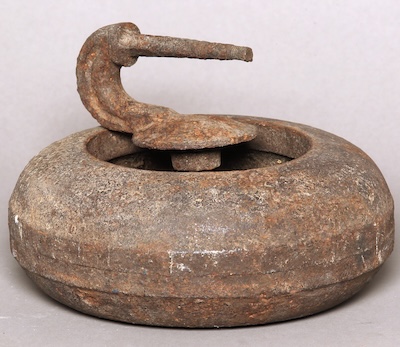
Curling in Quebec and Ontario was very different. It was played primarily in larger urban centres and was considered an elitist sport, favoured by older sportsmen. In Quebec, iron curling stones — which weighed about 20 pounds more than granite stones — were still preferred, while granite stones were regarded as something of an aberration. Curlers in Quebec, and in Ontario to a considerable extent, looked to Scotland as the mecca of curling and followed the traditions of the Royal Caledonian Curling Club (RCCC).
The way the game was played also differed considerably. In the West, curling was more freewheeling and wide open, with takeout shots commonly used. In the East, largely because of the heavier iron stones, the game remained primarily a contest of draw shots. Removing an iron stone from play was considerably more difficult.
It may be hard for people today to appreciate, but the rivalry between iron stones and granite stones was the major stumbling block to establishing a national curling competition like the Brier.
The Road to a National Championship
By 1924, the Manitoba Bonspiel had become the most significant curling event in Canada, attracting teams from various parts of the country. Although the event was already enormous, its organizers wanted to expand it further and looked to Montreal as a potential source of additional teams.
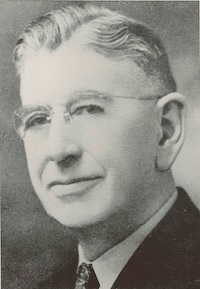
George Cameron was a member of the Manitoba Bonspiel’s executive committee and president of W. L. MacKenzie and Company, the representative for Macdonald Tobacco in Western Canada. He travelled to Montreal regularly and suggested to his committee that, on his next trip, he would approach some of the granite-stone curlers there to see whether they would be interested in travelling west to compete in the Manitoba Bonspiel.
Cameron did not manage to attract any new teams to the event, but he did succeed in convincing Macdonald Tobacco to provide a trophy for the bonspiel and offer a unique prize. The winning team would receive an all-expenses-paid trip to Eastern Canada to play a series of goodwill games, with Macdonald Tobacco covering the costs.
A team skipped by Howard “Pappy” Wood won the title and earned the right to travel east, accompanied by a small contingent of officials. The tour lasted two weeks and took the group to six cities. In the end, it helped foster stronger ties between Eastern and Western curlers. Another important outcome was that the tour introduced the granite-stone game to a number of iron-stone curlers in Quebec.
In 1926, the Manitoba Bonspiel was won by another Winnipeg team, this one skipped by George Sherwood. During the second tour, discussions began in earnest about establishing a true Canadian championship.
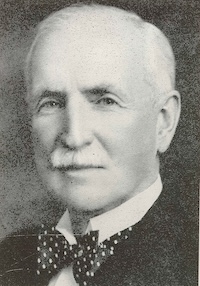
One particularly significant meeting took place in Toronto. It was chaired by Thomas Rennie, president of the Ontario Curling Association and a prominent figure in Toronto’s business community. Between them, Cameron and Rennie developed a plan under which Cameron would approach Macdonald Tobacco with a proposal to expand its support to a national men’s championship.
The proposal was well received by Macdonald Tobacco’s Montreal office. It marked the beginning of what would become a long association between curling, Macdonald Tobacco, and the company’s president, Walter M. Stewart.
Stewart had definite ideas about the structure of the event that would bear the name of his company’s tobacco brand. The competition had to be national in scope, with the eventual goal of attracting curlers from every corner of the country. Most importantly, he wanted the atmosphere to emphasize fun, sportsmanship, and friendly competition.
Stewart never attended the Brier and did not want the company to regard its support of the event as sponsorship. During the 50 years that Macdonald Tobacco supported the Brier, the company never budgeted its contribution as an advertising expense.
Nevertheless, the event took its name from one of Macdonald Tobacco’s brands, BRIER, which was marketed as the “heart of the tobacco.” We will explore this in a future story, but the idea of the heart eventually became an important part of the Brier’s symbolism. The explanation is straightforward: Brier was promoted as the heart of the tobacco.
It is interesting that Stewart chose to associate his leading pipe-tobacco brand with the championship, despite his aversion to using the Brier as an advertising vehicle.
Similarly, another Macdonald Tobacco brand, British Consols, was associated with the provincial championships, with one exception. These events became commonly known by the shortened name “The Consols.” In New Brunswick, a longstanding arrangement with Ganong Chocolates supported the provincial championship until 1980.
Stewart removed himself entirely from the operation of the Brier and appointed three trustees to oversee the competition. Thomas Rennie became the first chairman of the trustees, joined by Lieutenant-Colonel Peter Lyall of Montreal and Senator Jack Haig of Winnipeg.
The trustees, and those who succeeded them, ran the Brier until Macdonald Tobacco withdrew its support in 1979. When Walter Stewart’s son David took charge of the Brier in 1946, he joined the trustees as chairman.
The First Brier — March 1927
The trustees decided that the championship would be played as a round robin, a format that many believed would determine a true national champion.
The venue was largely determined by Macdonald Tobacco, and Toronto emerged as the obvious choice. The newly constructed Granite Curling Club had the largest single-covered artificial-ice surface in North America, and Thomas Rennie was a prominent member. The club was large enough to accommodate the expected crowds and had facilities for the various functions planned around the event.
The third decision proved the most difficult: selecting the teams.
Ultimately, the trustees decided to make the 1927 championship an invitational event. The chairman sent invitations to eight curling associations — some provincial and others representing individual cities, including Montreal and Toronto — to send teams to the inaugural competition.
The participating teams were selected in various ways. Some earned their places by winning bonspiels, while others were hand-picked. The clearest example of the latter was the eventual winning team from Nova Scotia, skipped by Dr. Murray Macneill.
Western Canada had just one representative: Ossie Barkwell of Yellow Grass, Sask. Barkwell earned his place by defeating Jimmy Congelaton of Manitoba in the final of the Manitoba Bonspiel.
The first day of competition drew large crowds. Many spectators had little idea what to expect, but one immediate attraction was the striking difference between the styles of play used by the Eastern teams and the lone Western representative skipped by Barkwell.
Eastern curlers had rarely seen the deliberate hitting game employed by the Westerners. The Eastern teams favoured patience, carefully building each end through precise draw shots. Barkwell would draw when the situation called for it, but he generally preferred the running shot, a style unfamiliar to many of his Eastern opponents.
In the end, Barkwell finished with a record of three wins and four losses. Two Eastern teams, skipped by Murray Macneill of Nova Scotia and Johnny Malcolm of New Brunswick, posted the strongest records of the week.
Macneill finished with six wins and one loss. His only defeat came against Malcolm in the second round, in a high-scoring 14-end game that Malcolm won 15–14. Macneill’s overall record earned his team the distinction of becoming the first-ever Macdonald Brier champions.
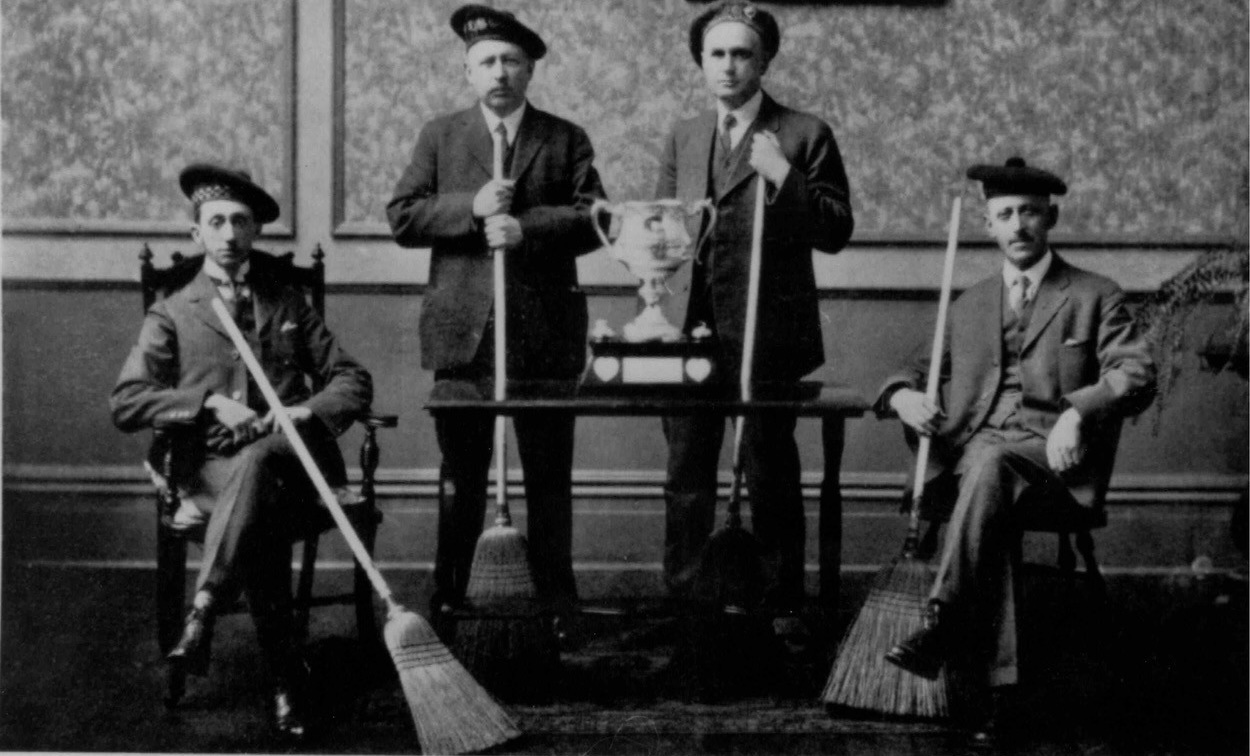
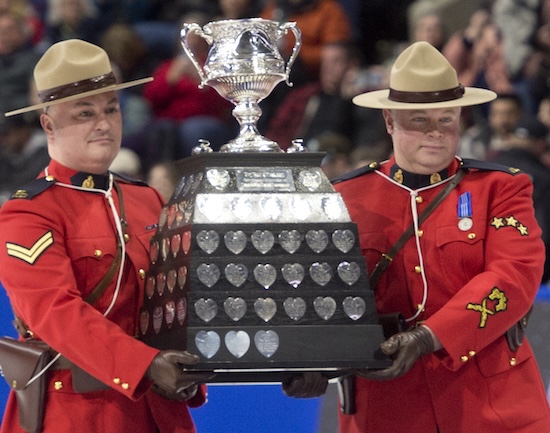
In the main room of the Granite Curling Club, Macneill, Al MacInnes, Cliff Torey and Jim Donahoe were presented with the Brier Tankard, silver tea sets, and solid-gold medallions.
The medallions were solid-gold replicas of the official Brier pin, which later became known as the heart pin. Each player had received one of these pins at the beginning of the competition. For the champions, the original competitor’s pin was replaced with a winner’s pin.
This tradition continued under Macdonald Tobacco until 1979. However, the winners’ pins awarded after 1927 were gold-plated; those presented to the inaugural champions in 1927 were solid gold.
(Reference: Canada Curls, by Doug Maxwell; The First Fifty, by Doug Maxwell; and The Brier, by Bob Weeks).