


By: Nolan Thiessen, Chief Executive Officer, Curling Canada
There’s a phrase that has become almost instinctive in all sport, not just curling.
“If you want to get better, you need to compete more.”
You see it particularly in youth sports. More, more, more, and it’s the same in curling.
Attend more bonspiels. Play in every playdown from U-18 to U-20 to Men’s or Women’s. Enter another championship. Measure yourself only based on how many games you played and spiels you win. We’ve built into our culture as a curling system that everyone gets to play in everything and the “cream will always rise to the top.”
Let me be clear: competition matters. I love competition. It reveals character. It finds the weakness you’ve been trying to hide as a team and exposes it, and it showcases who has prepared the most.
And anyone who has stood in the hack or beside a skip ready to throw a draw to the button with a national championship on the line understands that no practice can fully recreate those moments.
Competition matters but competition alone does not create high-performance excellence; it only reveals it.
Chapter six
High Performance – What it means to be excellent
From More Competitions to Better Environments
High Performance is a way of being
When Canadians think about high-performance curling, they naturally think about the years of championships memories delivered.
The Brier. The Scotties. The Trials. All of the World Championships hosted here in Canada and one’s we’ve watched from all over the globe.
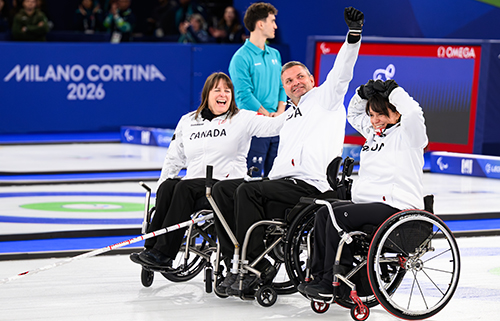
Those moments inspire us. For me watching Vic Peters win the 1992 Brier was the final piece of the puzzle to get me up from the masking tape rink in my parents’ basement to the rink down the street to try the game for real for the first time.
Those championship moments matter and they represent excellence at its highest level. They’re the culmination of so many years of hard work to get to that point for athletes. But that’s the key distinction. Those events show the work done; they aren’t the actual work of high performance. If we only focus on what happens under the bright lights, we misunderstand how champions are actually made. We misunderstand the hard work and discipline needed to be truly great.
Champions are not made on a championship Sunday. They are made on an ordinary Tuesday morning when nobody is watching or paying attention, when the discipline to do the hard stuff overcomes the fear of being average or mediocre.
It’s when the workout still happens even though you’re tired. When video is reviewed and your coach asks that difficult question: “Why did you play that shot?” and you answer with truth in order to improve. When a teammate holds you accountable with honesty and respect and asks for more. When you ask yourself, “Am I doing enough? What more can I do to achieve my goals?”
Championships reveal those habits and reveal who has the discipline. The event where the Championship is won, though, and the access to it do not create the Champion.
A quote often attributed to John Wooden has stayed with me for years.
“Discipline is doing what needs to be done, when it needs to be done, whether you feel like it or not.”
Whether he said those exact words or not almost doesn’t matter. The principle is timeless and can be applied to almost anything worth doing well. And it is where we need to go as a High-Performance culture in Canada.
High performance is not a moment. It is a habit. Championships are simply the public examination of private discipline.
This is the mindset I believe Canadian curling must and will embrace. If our definition of high performance begins with championships, we have started too late.
So our high-performance culture is going to begin with habits. With intentional practice. With curiosity. With reflection. With physical preparation. With mental preparation. With accountability. With choosing to improve, every single day, even when it is hard or you just don’t want to.
Not because someone is watching, but because excellence demands it.

How we define successful athletes
Instead of asking, “What was your result last weekend?” perhaps we should ask, “Did we get better last weekend?”
Instead of “How many National Championships can I play in this year?” perhaps we should ask, “How many opportunities exist to deliberately improve?”
Those are fundamentally different conversations.
One measures activity. The other measures progress and that is where High-Performance curling in Canada needs and will go.
Because the truth is that every championship event eventually ends. Every medal is eventually put into a drawer or hung up on a wall and every ovation fades.
But the great thing is that championship discipline remains. The discipline an athlete develops at 16 years old will still serve them way past when they can reasonably win a Canadian title. That championship discipline creates better people. The commitment to continuous improvement becomes part of who they are, not simply what they achieve and that is one of the greatest gifts high-performance sports can offer.
Not medals. Character.
High-Performance curling in Canada is fairly unique. We are one of the few sports where Canadians know we aren’t the plucky underdogs who are punching above our weight. We’ve always been the standard globally. With that comes demands for continued success and podium results. We will never run away from that pressure, that privilege to have expectations on us; we will always cherish that. Not because it’s something to handle and manage, but because it’s a responsibility.
But our champions of the future will not only be defined by the number of National Championships they attend or the number of Olympic medals we hang up. High-Performance curling in Canada will be defined by whether we become a nation that values the daily pursuit of excellence more than the occasional celebration of it, and whether our survival of the fittest turns into a pipeline of talent that puts in the work and tries to outperform the standard of excellence that the athletes before them set.
Championships are destinations.
Discipline is the journey And the journey has always mattered more.
Reflection
Before continuing, consider these questions:
- If competition disappeared for a year, would your organization or your team still become better?
- What is your current reward: learning, improving or winning?
- Are we investing as intentionally in coaches and support staff as we are in athletes?
- If someone walked into your program tomorrow, would they immediately understand the culture you’re trying to build?
Chapter 7 will delve into the systems that underly it all and how they truly develop an aligned vision.
The future of Canadian curling podcast - Episode 6
JOIN THE Conversation:
