By Warren Hansen
(Today is the second in a series of stories leading up to the 100th Anniversary edition of the Montana’s Brier, presented by AGI, taking place Feb. 26-March 7 in Saskatoon. Former Brier champion and Curling Canada events director Warren Hansen will take us through the history of the event that is regarded as the most famous national men’s curling championship on the world. Today, he looks back at the years of Macdonald Tobacco’s sponsorship of the Brier, from 1927 to 1979, and explores some of the distinctive features of the company’s involvement.
When Macdonald Tobacco agreed to sponsor the Canadian Men’s Curling Championship in 1926, company president Walter Stewart immediately distanced himself from the operation of the Brier. Stewart was a very shy man who was uncomfortable interacting with people. As a result, he established a structure for running the event that would not require his involvement in its day-to-day operation.
When the Brier began, there was no national governing body for curling in Canada — no Dominion Curling Association (DCA), Canadian Curling Association (CCA) or Curling Canada. This made it difficult to put even the simplest details in place. Recognizing the need for clear leadership, Stewart appointed trustees and gave them responsibility for making the major decisions associated with the Brier.
The DCA — the predecessor of today’s Curling Canada — was eventually established in 1935, with Brier trustee John Haig as its first president. Even after the DCA came into existence, Macdonald maintained the trustees’ role right through to the final Macdonald-sponsored Brier in 1979. There were always three trustees, and eight different men served in the position between 1927 and 1979, including, eventually, Walter’s son David Stewart.
The original trustees were Senator John Haig of Winnipeg, Peter Lyall of Montreal and Tom Rennie of Toronto. Their successors over the years were Ross Harstone of Hamilton, Colin Campbell of Toronto, Errick Willis of Winnipeg, Thane Campbell of Charlottetown and Ted Culliton of Regina. Tom Rennie was the original chair. When Stewart began attending the Brier in 1946, he also joined the trustee group and became its chair.
The initial chair, and perhaps the most significant of the trustees, was Rennie (1868-1952). Born in Markham, Ont., Rennie began curling in 1873, using wooden blocks in backyard bonspiels. He won the Ontario Silver Tankard eight times between 1909 and 1928. He was president of the Ontario Curling Association in 1925-26 and, in that capacity, joined George Cameron in making the presentation to Macdonald Tobacco to become the Brier’s sponsor in 1927. Rennie was considered one of Canada’s outstanding curlers, golfers and lawn bowlers of the century.
David Stewart
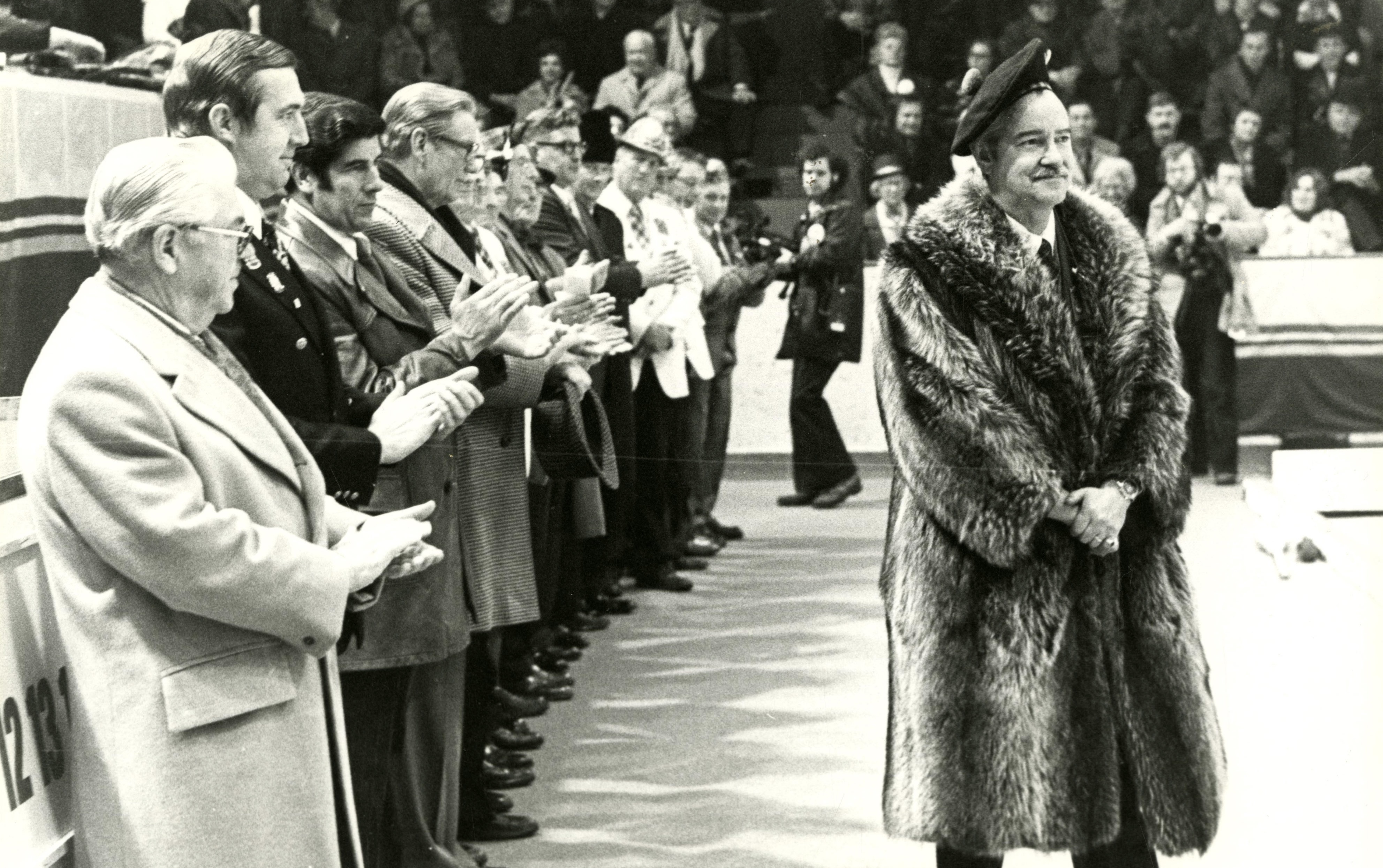
To thousands of people who played and followed curling, David M. Stewart was “the man in the coonskin coat,” who shyly appeared front and centre each March to present the Macdonald Brier Tankard to the four best male curlers in Canada.
The involvement of Macdonald Tobacco and the Stewart family was rooted in community service rather than in a sponsorship designed to generate commercial gain. The family was deeply patriotic and saw the Brier as a way to promote a sport it believed was part of Canada from coast to coast.
David Stewart was introduced to the Brier in Saskatoon in 1946. He was only 26 years old, quiet and shy, much like his father, who never attended the event. Walter did, however, direct his son to attend the Brier and present the trophy to the winners. When David presented the Brier Tankard to Alberta’s 1946 champion skip, Billy Rose, he wore a coonskin coat for the ceremony. The same coat was worn by the shy Montrealer every year for the trophy presentation, right through to the final Macdonald Brier in 1979.
David Stewart dearly loved the people who played the game, and he was genuinely fascinated by the many characters who wrote about and broadcast the Brier. I knew David and had more than one opportunity to chat with him about curling. He was a curious man who often asked for my opinion on various aspects of the sport because, as he saw it, I represented the new generation.
He was not a man who would ever be the life of the party and was usually reserved — except when it came to the media. Reporters were always welcome in his hotel suite. David and his wife, Lillian, looked forward to Thursday night at the Brier, when they hosted a party for the reporters and served pea soup. The gathering often lasted until the early hours of the morning.
Another highlight of every Brier was the Tuesday-night dinner hosted by David Stewart and Macdonald Tobacco. It was Stewart’s night to shine. The evening usually featured a classic dinner, followed by a performance from a well-known Canadian entertainer. The performer was always a surprise.
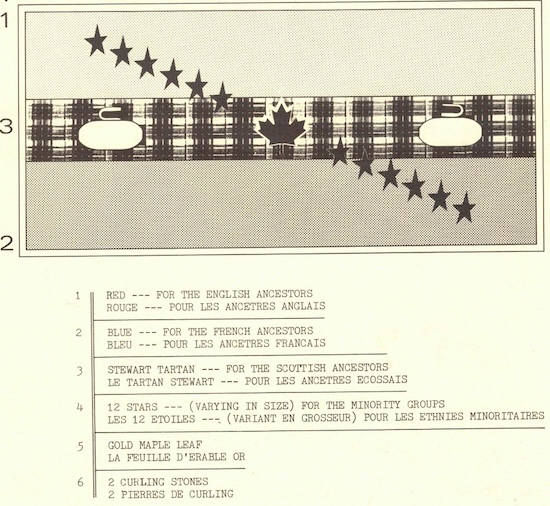
During the evening, Stewart would take the floor and talk about a distinctive piece of history associated with the area hosting the Brier. At the beginning of the dinner, however, he would show a projection of what he believed the true flag of Canada should be (see image with explanation). Stewart had a passion for Canadiana and curling, and he felt that curling was the glue that bonded Canada together.
We will discuss the final Macdonald Brier and the end of the sponsorship in a later story. For now, it seems appropriate to recall a quotation from David Stewart’s final Brier statement in 1979:
“We initially set out to take the Brier to every province in Canada, every provincial capital and as many other cities that make up the country, as possible. I think we did it right.”
The crowd at the dinner rose to its feet in a standing ovation — one that assured David the attendees believed he and his colleagues had indeed done it right.
The Brier and the Media
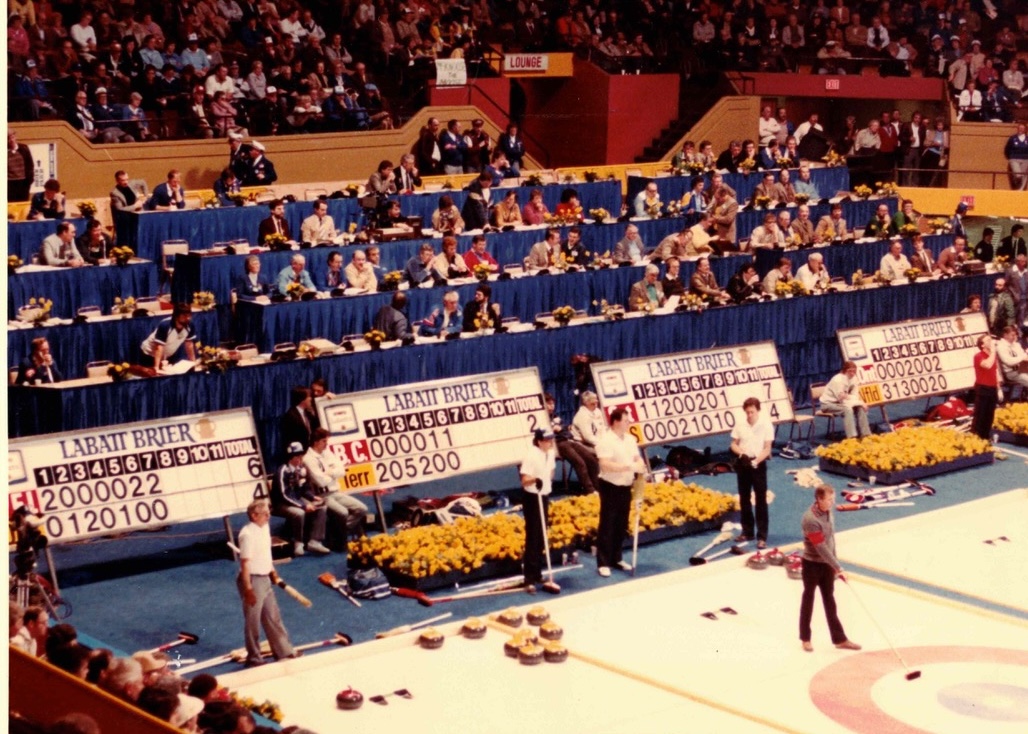
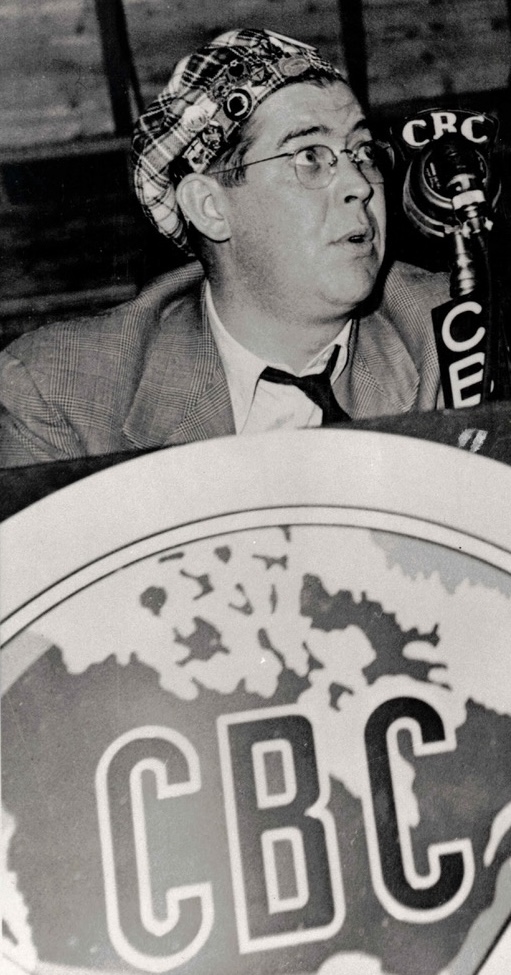
Before 1946, the Brier had more or less flown under the radar of the national media. That changed in Saskatoon in 1946, when the event was broadcast nationally by CBC. It also marked the beginning of much stronger newspaper coverage.
That same year, Macdonald Tobacco introduced Reg Geary to the Brier. Geary was a professional public-relations man who helped ignite media interest in the event. He travelled across Canada, meeting with media representatives in communities throughout the country in an effort to build interest and encourage coverage.
Media coverage of the 1946 Brier was extensive compared with previous years. A large contingent from Saskatoon attended, along with reporters from Winnipeg and Regina. The event also had an exciting finish: a three-way tie forced two playoff games, which ended at 3 a.m. The script could hardly have been better for attracting national media attention.
The following year, the Brier moved to Saint John, N.B., and the media contingent doubled. When the event went to Calgary in 1948, the numbers tripled. From then on, media interest continued to grow, as did Macdonald’s relationship with the press. The company also hired two of the country’s best-known sports-media personalities, Bill Good of Vancouver and Jack Wells of Winnipeg, as advisers and confidants.
Over time, a number of attractions were added to the annual Brier media party on Tuesday evening. Special media awards were introduced, including Man of the Year, Rookie of the Year, Best Story of the Year and Best Broadcast of the Year. The stronger media presence also led to the formation of the Canadian Curling Reporters (CCR) association, which became responsible for selecting an all-star team beginning in 1965.
By the end of the Macdonald era in 1979, the media bench could seat 100 people. Along with writers and reporters representing media outlets across Canada, there was another interesting group that I will call “stringers.” I know this side of the story well because I was a stringer from 1975 to 1989.
Remember, this was before TSN covered every draw on national television. In many parts of the country, there was a demand for up-to-date results. A stringer often represented a radio station somewhere in the country and sent reports back to that station every four or five ends. Some of us represented three or even four stations. I often filed reports for CKWX in Vancouver, CHED in Edmonton and CFNB in New Brunswick. By the end of the Macdonald era, it was not unusual to have 15 to 20 stringers on the media bench.
Under Labatt’s sponsorship, which began in 1980, the media contingent continued to grow. Media benches were being built to accommodate as many as 125 people.
The 1990s, however, brought the digital age. Slowly but surely, the way news was gathered and reported began to change. As a result, the media bench started to shrink. As we all know, the media world today is very different from what it was during the final glory days of the Macdonald Brier.
The old Brier media contingent was full of characters who, unknown to the wider world, were part of a second show taking place behind the scenes at every event. In 1979, the renowned Winnipeg sports editor Jack Matheson wrote:
“The Brier will survive without the Baldwins, Campbells and even the Richardsons, and it will eventually have to without Cactus (Jack Wells), Breathless (Bill Good), Woody (Larry Wood), Finger (Ted Thonger), Kingfish (Ray Kingsmith) and Buckets (Don Fleming) … but for sure it will not be as much fun.”
The Brier and Curling Canada
When the Brier began in 1927, there was no national curling association. It’s been suggested that the Brier was a catalyst in the formation of the Dominion Curling Association, and there is some validity to that idea. Attempts to establish a national curling association in Canada had been made as far back as 1852, but none had succeeded by 1927.
A historic meeting was held in Toronto concurrent with the 1928 Brier. At that meeting, preliminary steps were taken toward forming the DCA, with two objectives:
- The governing of visits to and from Scotland by Scottish and Canadian curlers.
- The establishment of standard curling rules, specifically for the Brier.
Progress was slow. Finally, in Toronto in March 1934, a resolution was passed to appoint a committee to prepare a draft constitution. The committee would present it to representatives at the next meeting, scheduled for Toronto in March 1935.
The DCA officially came into being on March 6, 1935, after many years of false starts. The founding meeting took place at the Granite Curling Club in Toronto. Senator John T. Haig, who was also a Brier trustee, was elected the association’s first president.
In 1967, the organization became the Canadian Curling Association (CCA). In 1990, the CCA continued under the same name but expanded to include all members of the former Canadian Ladies Curling Association (CLCA). Following a rebranding in 2015, the organization became known as Curling Canada.
Because the DCA did not exist in 1927, Macdonald Tobacco, with the assistance of the various host committees, was fully in charge of operating the Brier. Although Macdonald Tobacco communicated with the DCA about the event, the DCA (later the CCA) had little involvement in its operation until 1980.
When Labatt became the new sponsor in 1980, an agreement was reached under which the CCA operated and was responsible for everything between the boards — essentially, the field of play — while Labatt handled everything else.
After the conclusion of the 1994 Brier, Labatt continued as sponsor, but under an entirely new arrangement. The St. Clair Group now held the marketing rights to the Brier. In 1995, the CCA became fully responsible for operating the event, and that arrangement continues today.
(Reference: Doug Maxwell, The First Fifty)