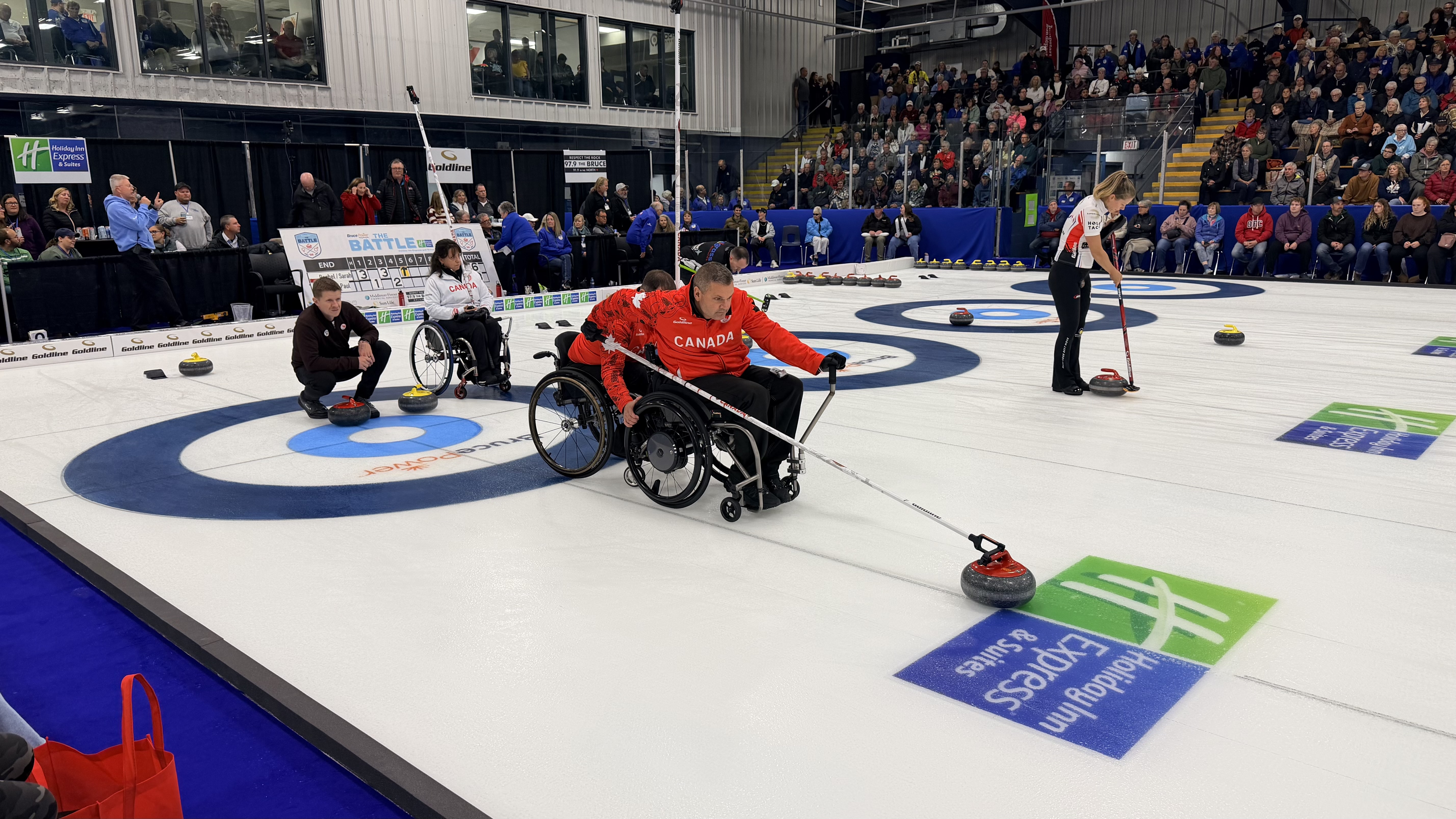
Community is what drives wheelchair curling in Canada and remains the focus of the newly launched Wheelchair Curling Pathway (WCP). The largest group of athletes in the WCP is found in the Pursuit Program’s Identification Stream, with 18 athletes and coaches currently involved.
Serving as the pathway’s welcoming entry point, the Identification Stream plays a key role in the WCP’s future growth. This stage of the program is designed for anyone curious about wheelchair curling — whether that means exploring the world of high performance, exchanging ideas about how to grow the sport in their own community, or both. It aims to be a safe, supportive, and exploratory space where individual ambitions and the collective goal of building wheelchair curling across the country can grow side by side.
Athletes and coaches in the Identification Stream are connected through a nation-wide community with open communication channels, resources, webinars, and newsletters. It’s a collaborative program that participants can opt in or out of at any time, with each person bringing their own goals—some focused on their personal pursuit of high performance, others on strengthening the sport in their clubs, towns, and provinces.
“Not every athlete joins the Identification Stream with Paralympic ambitions. Most people join because they want to be better connected to the community, with stronger ties to national program staff and resources that can support their own development. Many also bring those resources back to their clubs and regions to help grow the sport locally,” said Kyle Paquette, Director of Wheelchair Curling at Curling Canada. “The growth of the sport in large part depends on this community, and many of these athletes and coaches have played, and continue to play, an extremely important and active role—one that we’re looking for ways to further support.”
That sense of connection is echoed by Mick Lizmore, National Program Head Coach. “The Identification Stream is a space for athletes and coaches to connect across the country and support each other—whether that support is aimed at growing and building wheelchair curling in their region or pursuing higher levels of performance for themselves,” he said.
Across Canada, six provinces are represented in the Identification Stream:
Alberta:
- Emma Nagel (Athlete; Leduc)
- Martin Purvis (Athlete/Coach; Calgary)
- Stephen Hoffort (Athlete; Calgary)
- Wendy Frazier (Athlete; Calgary)
- Rick Jenkyns (Coach; Edmonton)
Ontario:
- Jeff Harris (Athlete; Toronto)
- Joanne Berdan (Athlete; Omemee)
- Lesleigh Elgie (Athlete; Brantford)
- William Simon (Athlete; Cobourg)
- Don Fleming (Coach; Peterborough)
British Columbia:
- Katie Combaluzier (Athlete; Squamish)
- Kim Egger (Athlete; Surrey)
- Marney Smithies (Athlete; Delta)
- Martin Matsutani (Coach; Vancouver)
Nova Scotia:
- Edie Lloyd (Athlete; Grand Pré)
- Nicholas Taylor (Athlete; Cooks Brook)
Québec:
- Christian Lentz (Athlete; Dolbeau-Mistassini)
Saskatchewan:
- Zahra Ehsani (Athlete; Regina)
For these athletes and coaches, the Identification Stream is also a space to explore what high performance could look like for them. One of the goals is to help athletes determine their interest, fit, and potential for future progression in high-performance wheelchair curling.
Part of that is supporting athletes’ understanding of their classifiability—whether or not they meet the international classification guidelines established by World Curling and the International Paralympic Committee.
“I have a muscle degenerative disorder, so I unfortunately cannot classify for international competition in wheelchair curling,” said Emma Nagel, a two-time provincial champion and an avid advocate and grower of the game in Alberta. “I’m still interested in competitive play at championships, getting to know more about my game, and understanding how I can help my teammates.”
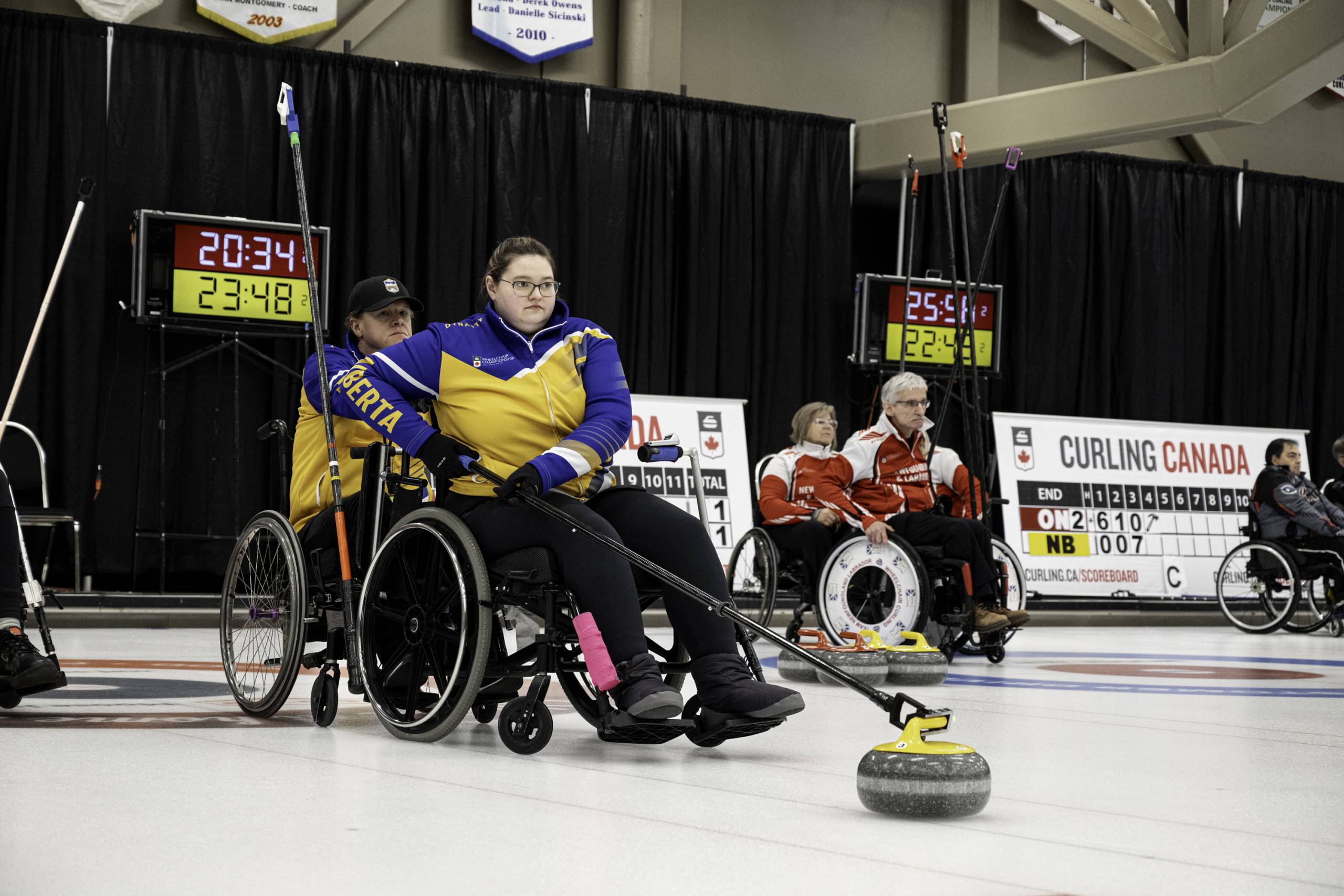
While Nagel is not eligible for international classification, she, like many other athletes, is able to participate through Canada’s domestic classification, which is designed to create a more inclusive landscape for athletes to get involved and participate in wheelchair curling across the country. Nagel champions the new WCP structure for its ability to create a close-knit community even at a great distance.
“When I started, I really only knew people from Edmonton and Calgary,” she said. “Once I got involved [with the National Wheelchair Curling Program], I was able to meet lots of different athletes, and a lot of them have become my friends.
“I keep in touch with everybody. The community is so welcoming and amazing. If you have any questions, everyone is open to answer them, and we all have different viewpoints we’re easily able to share.”
That kind of cross-country connection is still growing. While the Identification Stream cohort is expected to change throughout the year, with participants able to opt in or out at any point, currently nearly 80 percent of the group is made up of only three provinces. Expanding that reach is a priority for the program this quadrennial, with the goal of seeing involvement from every province and territory across the country.
The community in wheelchair curling is what keeps the sport thriving, but that’s only possible with nation-wide support. In order to continue to grow wheelchair curling in Canada, provincial and territorial associations are encouraged to spread the word and grow the game in their communities.
“There’s been so much exciting growth in the sport, but there’s still lots of work that can be done,” said Nagel. “We don’t want it to fizzle out. Helping people become more aware of wheelchair curling can bring more light and more participation to the sport.”
Building a stronger and more connected wheelchair curling community remains a key focus of the WCP as participation continues to grow across the country.
“As we continue to build out the Identification Stream, we want to make sure athletes and coaches across the country feel that sense of community,” said Lizmore. “We’d love to see involvement from even more provinces and territories in the near future, and we’re committed to providing that space to give back to the community that defines the sport and carries it forward in Canada into the next quadrennial.”
The WCP strives to be inclusive and is always looking to expand, with prospective athletes invited to submit declaration forms throughout the year. To fill out a declaration form, click here.
For more information on the WCP, click here.